
Cleaning Around Vending During a Wet Floor Closure: Coordinate Customer Access
Floor cleaning around vending needs coordination when the area is temporarily closed. Customers may focus on reaching the machine and overlook a barrier that changes their usual route. Plan the cleaning period with the site team so that the closure, alternative access and reopening are clear. Do not keep vending access open at the expense of the building’s normal cleaning and safety arrangements.
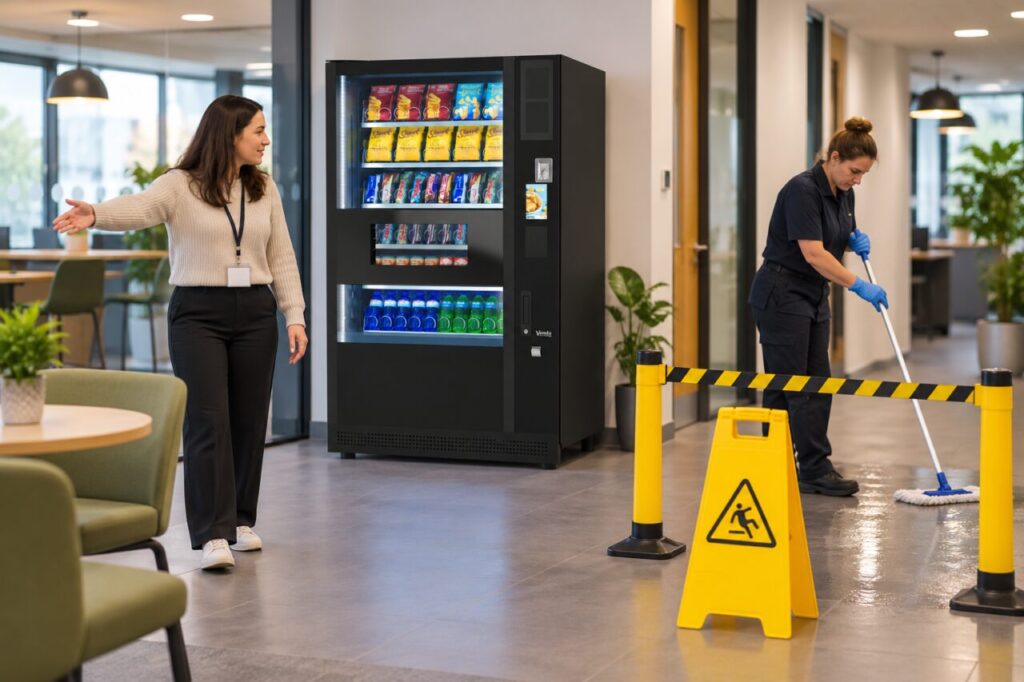
Define the area being closed
Ask the cleaning supervisor which part of the floor needs to be kept clear and for how long it is expected to remain unavailable. The answer should come from the actual cleaning method and site procedure, not a generic waiting time. Include the approach to the machine and the route away from its collection area when discussing the boundary.
Check whether customers would have to cross the affected area to reach another doorway or bin. A barrier positioned only directly in front of the machine may fail to explain the wider closure. Agree the layout with the responsible team and make sure it does not obstruct required exits or create a new access problem elsewhere in the room.
Explain availability in ordinary language
Use a brief factual notice stating that access is temporarily unavailable because floor cleaning is in progress. If there is an approved alternative vending point, give accurate directions. Do not promise that the original machine will reopen at an exact time unless the responsible team can support that promise. An estimated time should be identified as an estimate.
Keep the message separate from a machine-fault notice. Customers need to understand whether the cabinet itself is unavailable or whether they cannot safely approach it. If equipment must be taken out of service as part of the work, coordinate that through the authorised operator. Cleaning staff should not need to improvise controls or disconnect unfamiliar equipment to manage customer expectations.
Protect the operating arrangement
Tell the vending coordinator if cleaning will overlap with a refill or service visit. A trolley arriving during the closure may create avoidable waiting or pressure to reopen early. Agree the sequence of work beforehand. If plans change, give the operator the updated access information rather than assuming reception will explain it on arrival.
For the wider vending arrangement, record who coordinates room access and who handles equipment issues. The fully managed service description covers replenishment and technical care, while local cleaning access still needs to be agreed with the site. This division prevents a floor-cleaning issue from becoming an unnecessary technical call-out.
Reopen through the normal site process
The responsible cleaning or facilities person should decide when the area is ready to reopen under the site’s procedure. Do not use the absence of visible puddles as your own substitute for that decision. Once access is restored, remove outdated notices and barriers through the agreed process so that customers are not left guessing whether the machine is available.
Check that cleaning equipment has been stored away and the normal approach is clear. If a spill, damage or unusual condition is noticed at the machine itself, report it separately with the location and observation. Review recurring timing conflicts with the site team. A practical cleaning schedule should allow the required work to happen while giving customers and visiting operators a clear, consistent message about access.
Related guidance: Cleaning Vending Exteriors: Keep the Cloth and Method Suitable for the Surface.
Planning vending at your site? Contact the team with your location, equipment details and requirements.