
Can an employer pay the first euro of a vending purchase?
An employer can propose paying the first euro of an eligible vending purchase, but ask the operator to demonstrate the arrangement on the actual payment setup before announcing it. The customer needs to know their own share before confirming. The employer needs a record of what it funded, and the operator needs a way to reconcile both amounts for the same successful vend.
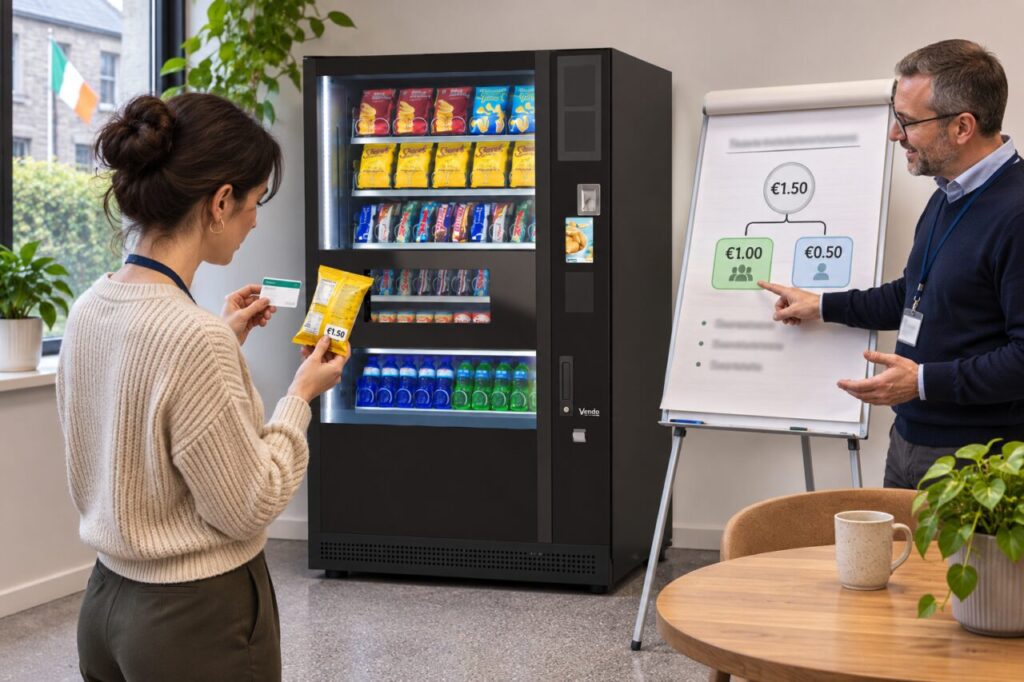
Write the rule using three real buying situations
Start with an example rather than the word ‘subsidised’. If a snack costs €1.50 and the employer covers up to €1 per eligible purchase, the employee pays €0.50. If a second snack costs €0.80, the employer would cover €0.80 under that rule. Decide explicitly whether the unused €0.20 disappears, carries forward or has some other agreed treatment. A fixed allowance per visit is different from a credit balance that accumulates.
Now consider somebody who buys two items in quick succession. Does the contribution apply once per item, once per transaction or once per shift? Those rules can produce very different costs and customer experiences. Document the intended outcome before asking the provider to configure it. The examples here describe an illustrative policy and make no claim about a particular machine’s capabilities.
Watch the complete payment sequence
Use an authorised test identity and the same reader, machine and account arrangement proposed for the site. Ask someone unfamiliar with the benefit to select an eligible product. Observe when the full price, employer contribution and employee balance become clear. If another payment is required, check which methods can complete it and what happens if the employee cannot or does not want to continue.
Repeat the test with an ineligible item, a cheaper item and a purchase after the allowance has already been used. Ask the operator to demonstrate the supported failure or cancellation process without deliberately damaging or obstructing the machine. Establish whether a failed vend consumes the allowance and how an incorrect debit is corrected. Keep the test results before agreeing a launch date.
Follow a purchase into both records
For the €1.50 example, ask the provider to show the completed sale, the €1 employer amount and the €0.50 employee amount in the relevant reports. Someone reviewing the monthly statement must be able to connect these figures without counting two sales. Check how a reversal appears and whether an employer contribution is adjusted on the same report or a later one.
Agree what information the employer actually requires to administer the scheme. Aggregated totals may answer the budget question. Ask the provider about available reporting and restrict access to what the authorised people need. Do not publish staff names or individual purchase histories on a notice beside the machine.
Explain the benefit in everyday terms
Give staff one normal purchase example, the eligibility conditions and a contact route if the result differs. Include the start date, any limit and what to do if the reader does not recognise an entitlement. If the provider cannot demonstrate partial payment, choose a supported arrangement and rewrite the staff notice before distributing it.
When exploring workplace vending options, distinguish the equipment arrangement from the decision to subsidise products. A venue receiving equipment under a placement agreement does not automatically mean every product is free. The after-hours office guide can help you consider how the same benefit would work for a different shift.