
Fixed rent or a share of vending sales: when do the two site fees match?
A site owner offers two ways to pay for a vending position: a fixed amount each month or a percentage of sales. You can find the turnover at which the two fees match by dividing the fixed amount by the commission rate expressed as a decimal. First agree what ‘sales’ includes. The neatest calculation is useless if each party is using a different turnover figure.
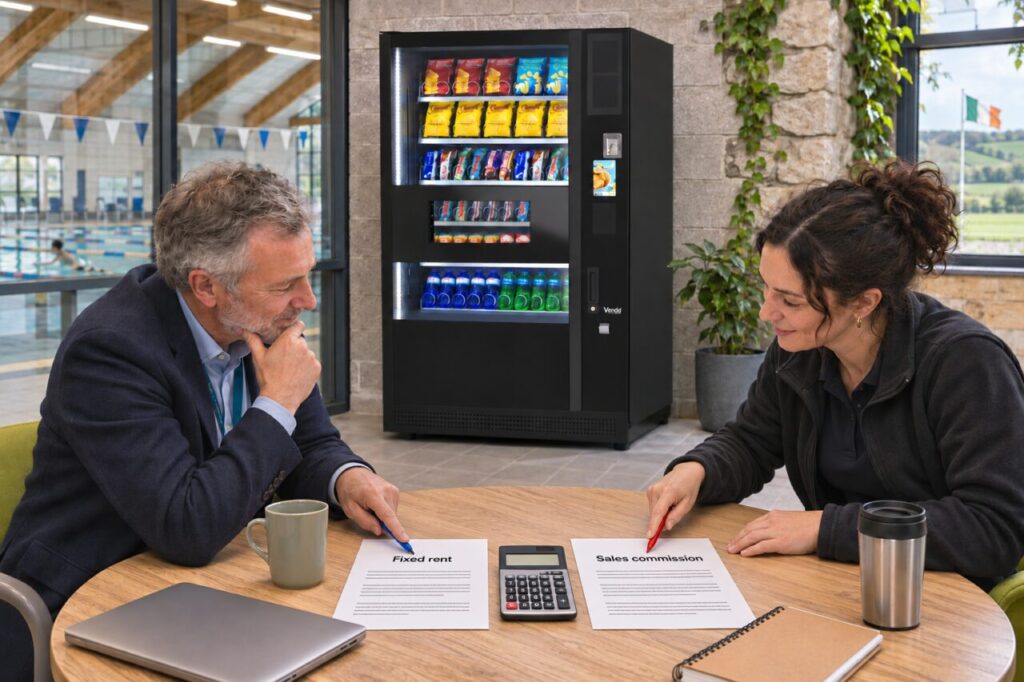
Find the crossing point
Suppose an operator is offered rent of €120 a month or ten per cent of eligible sales, with no minimum and otherwise identical terms. The figures are invented for illustration. Dividing €120 by 0.10 gives €1,200. At that monthly sales level either option costs the operator €120. Below it the percentage fee is lower. Above it the fixed fee is lower.
Try two other figures to make the direction clear. At €800 of eligible sales the commission is €80, which is €40 below the fixed rent. At €1,800 the commission becomes €180, or €60 more than the rent. The venue owner sees the other side of the same figures. This explains why parties with different expectations for the site may prefer different arrangements.
Define the amount the percentage uses
Ask whether the calculation uses completed sales before or after refunds, the treatment of taxes and container deposits, and how employer-funded purchases are handled. Obtain appropriate advice for the accounting and tax treatment of the actual agreement. A card settlement after processing fees is not automatically the agreed sales figure. Cash purchases may also need to be included, depending on the terms.
Choose a sample month and have both parties calculate the fee independently from the same report. Work through one refund falling in a later month. Does it reduce the later calculation or adjust the earlier one? Our guide to revenue before and after refunds explains why the reporting periods matter.
Test seasonal months and closures
A fixed monthly charge can apply even when a venue opens fewer days. Percentage commission moves with eligible sales under the simple example. Check whether rent pauses during a closure, whether commission has a minimum guarantee and whether either model includes a separate service or utilities charge. A percentage with a monthly floor has a different shape from a straight percentage.
For a seasonal site, calculate twelve separate months. An annual total can conceal a run of low months when the operator must pay rent before the busier season starts. Show the actual payment dates and any deposits or adjustments. For the venue, record the uncertainty around commission income rather than relying on a single optimistic sales forecast.
Compare what the payment buys
Agree the cabinet position, access hours, electricity arrangement, cleaning boundary and any right to move the machine. Confirm how the operator reports sales and when the parties review the agreement. A better position or longer opening window can affect the decision, but its value should be supported by observed use or clearly labelled assumptions.
When discussing vending arrangements for an Irish site, bring both the commercial offer and a realistic range of monthly sales. The crossing point is a practical negotiating reference. The final decision still depends on the site’s costs, access and demand.