
Is an unheated entrance lobby suitable for indoor vending in winter?
An indoor lobby can become surprisingly cold when its external doors open repeatedly or the building’s heating is reduced overnight. Do not assume an indoor vending cabinet is suitable merely because rain cannot fall directly on it. Ask the supplier to assess the lowest expected surrounding temperature and the actual operating conditions before you commit to that location.
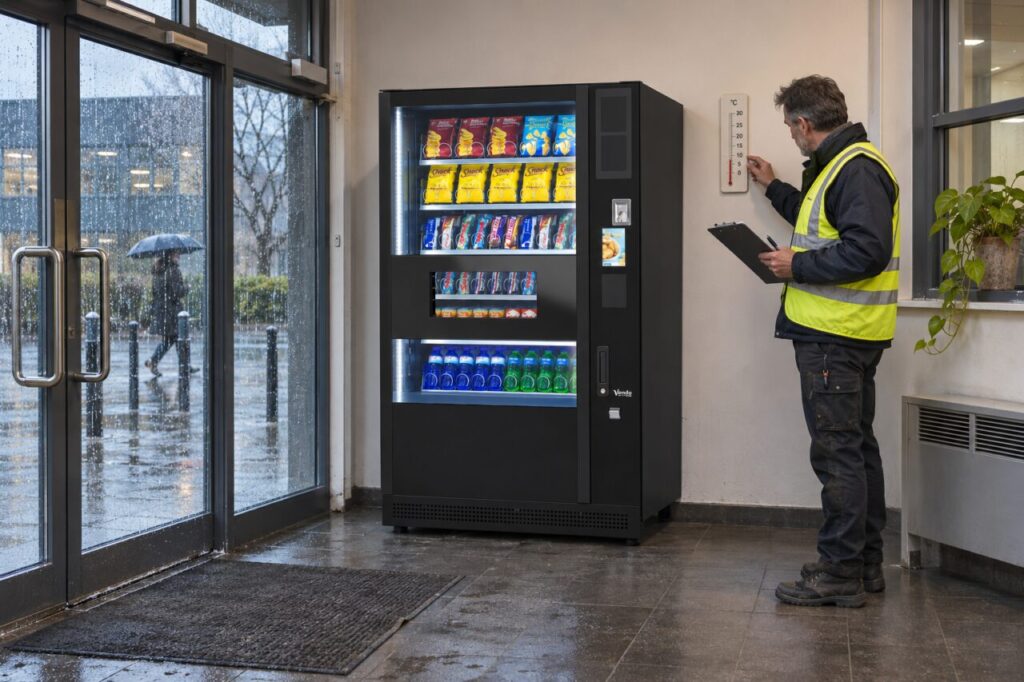
Distinguish room temperature from cabinet temperature
A refrigerated machine’s internal setting and its permitted surrounding conditions are different information. The SandenVendo G-Snack Evolution AMX data sheet, for example, lists an internal temperature range separately from its climate class. Read the applicable document for the exact model and configuration; do not treat another cabinet’s figures as a universal rule.
A colder room does not automatically mean better refrigeration or safer storage. Ask the supplier what the proposed equipment requires, including any restrictions relevant to the entrance. Avoid experimenting with heaters, insulation or altered controls to make an unsuitable position work. Any environmental problem needs an approved solution, not an improvised change around a powered cabinet.
Measure the conditions the machine will actually face
Ask the facilities team what happens to heating before opening, at weekends and during longer closures. Record the proposed position relative to external doors and draughts. A single reading during a busy, heated afternoon does not establish the minimum conditions. Discuss a suitable observation period and recording method with the supplier so the evidence answers the compatibility question.
Keep weather exposure separate from temperature. Wind-driven rain, wet cleaning, condensation and damp clothing can create different issues. Explain the entrance layout and any history of water entering the area. The supplier needs the full environment, including whether the machine would sit in an unheated vestibule or beyond a second set of doors in a controlled interior room.
Compare locations before modifying the building
Consider moving the proposed machine farther inside while keeping it easy to find. Compare customer access, refill access, power availability and the route for delivery at each position. Ask for any necessary building work to be priced separately. A more convenient place for customers may still be unsuitable if it cannot support the equipment or the intended product range.
For vending equipment in an Irish venue, send the installer the location information before ordering. The guide to summer room temperatures addresses the other end of the environmental range. A sensible survey considers both seasonal extremes rather than accepting a site because it worked during one mild demonstration.
Make the operating arrangement durable
Once the location is approved, record any assumptions that must remain true. These might concern room heating, closed doors or access to ventilation. Give the relevant information to facilities and cleaning staff. A later energy-saving change to the building should prompt a review if it changes the conditions on which the equipment assessment depended.
Ask the operator what information to record if temperatures or equipment behaviour fall outside the agreed arrangement. Keep food-storage decisions with the responsible food business and technical decisions with the authorised service team. Do not advertise a year-round unattended service until the site and supplier have established how the machine will operate through the building’s quietest and coldest periods.