
An Anonymous Office Vending Survey Receives Repeat Responses: Explain the Limitation
An anonymous office vending survey can collect useful preferences without identifying every respondent. It can also leave uncertainty about whether someone answered more than once. If repeat submissions are possible, describe the results as responses rather than automatically treating them as a count of distinct employees.
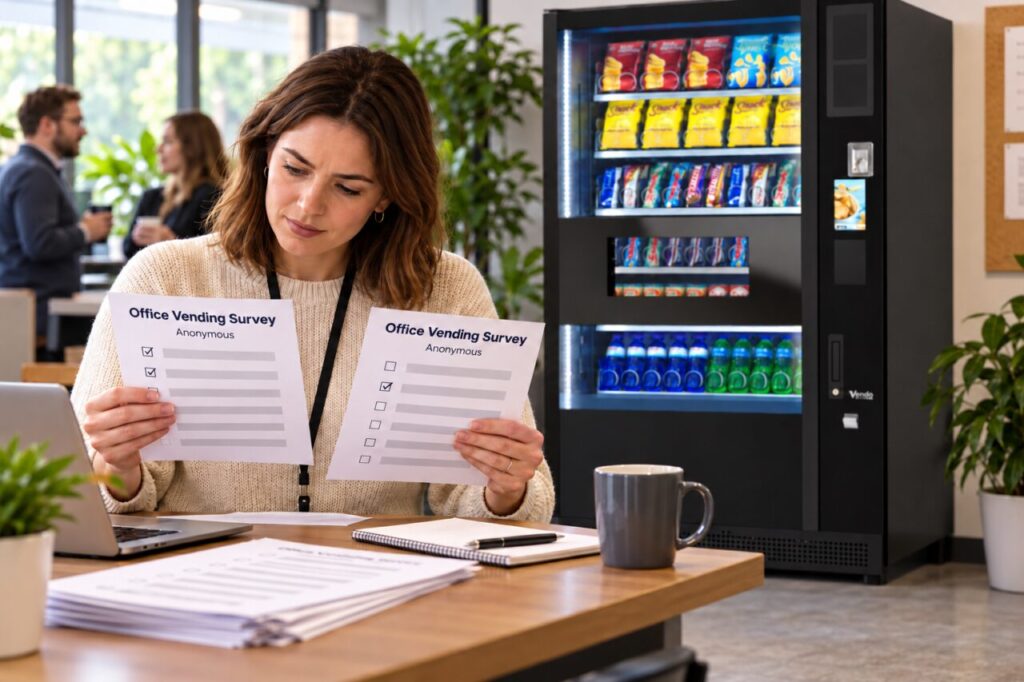
The right response is proportionate. You do not need to identify individual colleagues to acknowledge a limitation. Keep the feedback useful while avoiding an exaggerated statement about how many people support a product change. A survey can inform a small trial even when it cannot provide an exact measure of unique demand.
Check how the survey was configured
Ask the survey owner whether the form limited submissions and whether that setting was active throughout the collection period. Record what the tool actually confirms. Do not assume that a shared link enforces one response per employee, or that identical answers prove the same person submitted them.
Check whether the form was revised or redistributed during the exercise. A colleague may have reasonably believed that a second invitation was a new survey. Keep the invitation dates and wording with the results. This explains possible duplication without blaming respondents or inventing a technical explanation that the form records do not support.
Use accurate labels in the summary
Suppose, purely as an example, the form contains 60 submissions from an office of 100 eligible people. If unique participation cannot be verified, report 60 responses received. Do not automatically call that a 60% employee response rate. The number of distinct people could be lower, and the available evidence does not establish exactly how much lower.
Keep the original counts beside any percentages. If 30 responses request a particular drink, say that 30 submissions selected it. Avoid converting that into a guaranteed number of regular buyers. Preferences, unique participants and actual purchases are different measures, even when a survey has excellent submission controls.
Avoid arbitrary deletion
Do not remove identical responses merely because they look repetitive. Several colleagues can genuinely prefer the same products. If the survey platform provides a documented way to identify a known duplicate submission without undermining the promised anonymity, ask the survey owner to apply a clear rule and record it consistently.
Otherwise, retain the data and state the limitation. A transparent caveat is more defensible than quietly editing the results until they look plausible. Keep a copy of the original export and distinguish any cleaned version from it, including the reason and method for changes that were actually justified.
Turn uncertain feedback into a modest test
Use the responses to identify a shortlist, then discuss a manageable product trial with the operator. Record availability, sales and further comments during the trial. Do not order a large quantity on the assumption that every survey vote becomes a purchase. Check whether the requested pack suits the equipment and the existing range before adding it.
For the next survey, explain whether it is anonymous, whether repeat submissions are prevented and what the results will be used for. Keep the invitation clear and the collection period consistent. Better survey design can reduce uncertainty, but honest reporting remains necessary: a preference exercise supports a decision; it does not replace observation of how the vending service is actually used.
Discuss your site and equipment requirements with Vending-Machines.ie, or send an enquiry with the questions your comparison has identified.
Related guidance: Office Vending Survey Response Rate: Show Who Was Invited as Well as Who Replied.