
A vending sale is refunded: which payment charges remain in your costs?
A full refund to a vending customer does not tell you whether the payment provider has returned every charge associated with the original transaction. Check the merchant terms and settlement record before treating the sale as having zero payment cost. Different fee components may be handled differently, so a useful reconciliation follows both the customer amount and the provider’s charges.
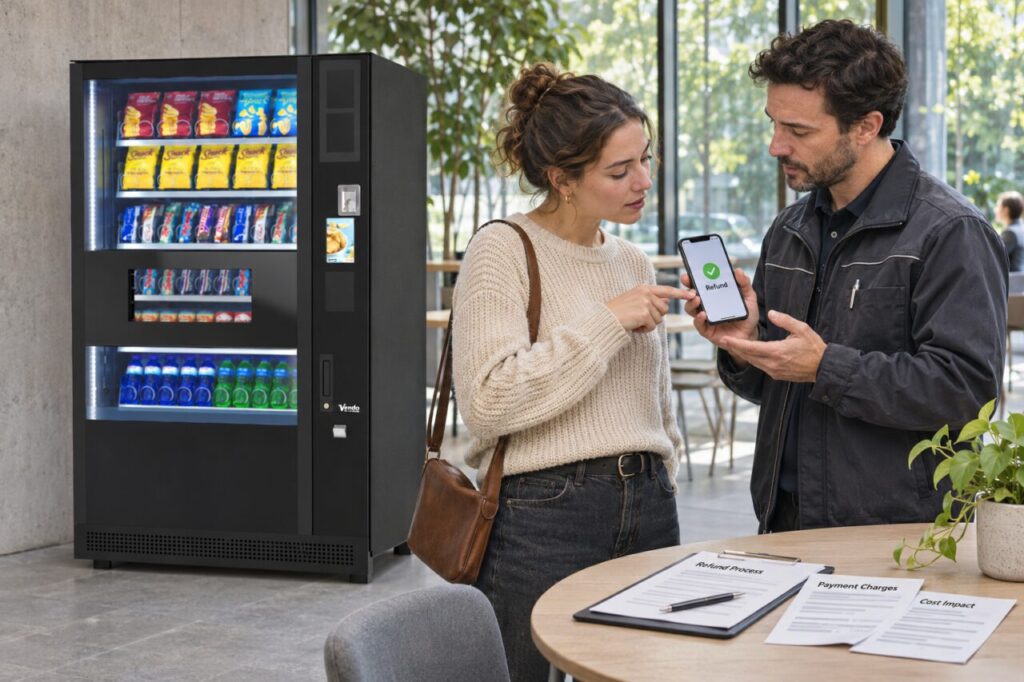
Identify the transaction and the type of correction
Record the original sale reference, date, amount and machine, then link the authorised refund record to it. Distinguish a refund of a completed sale from a cancelled or unsuccessful payment. Do not assume a pending amount on a customer’s banking app has the same meaning as a settled transaction in the merchant report. Ask the payment provider to explain unclear statuses.
Keep personal payment information out of shared operational notes. Use the provider’s approved reference and support process rather than collecting full card details. If the refund concerns a failed vend, retain the equipment case reference separately. That allows you to reconcile the money while also investigating why the product did not reach the customer.
Read the fee schedule at the component level
Ask whether the original percentage charge, fixed transaction charge and any separate refund charge are returned, retained or applied differently. Identify which document and version governs the account. A headline processing percentage may not describe every line in a settlement. Do not borrow a fee rule from another operator or another provider and apply it to your own machine.
Check whether monthly account charges are independent of individual refunds. A subscription or minimum monthly amount may remain payable even when a particular sale is reversed. The guide to minimum monthly charges explains why the total bill can behave differently from a simple sum of percentages on successful sales.
Use a small reconciliation example
Consider a purely hypothetical €2.00 sale followed by a full €2.00 refund. Suppose the original payment fee was €0.08, the provider retains it and there is no additional refund charge. Sale income and the customer refund cancel each other, but the €0.08 remains a payment cost. Those assumptions are illustrative; confirm the actual treatment in your own agreement.
If the provider instead returns the original fee, the payment-cost result for that example changes. Keep each movement on its own line rather than editing the original sale to make it disappear. Where the refund arrives in a later reporting period, retain the link between the records so a monthly review does not mistake the timing difference for an unexplained shortage.
Use the finding to improve operations
Separate customer refunds caused by dispensing faults from duplicate requests, account corrections and other reasons. Use factual categories supported by the records. A repeated mechanical problem may create product loss, support work and payment cost together. The report should help identify that pattern without treating a legitimate customer refund as the source of the underlying equipment issue.
When comparing cashless vending proposals, ask for the complete payment arrangement and the refund process alongside the equipment price. Keep customer-facing guidance simple and prompt, while the operator handles fee reconciliation behind the scenes. Review the provider’s actual statement after a test or first genuine refund rather than assuming the contract wording has been interpreted correctly.