
Before buying vending, test how a seated customer collects the product
A customer can reach a vending screen yet still struggle to collect the purchased item. Before buying equipment for a venue used by wheelchair users or people who need to remain seated, test the full journey at the proposed position. Product collection deserves its own observation rather than being assumed from a specification sheet or a photograph of the cabinet.
Invite an appropriate practical assessment
Work with users and the people responsible for accessibility at the venue. Explain the purpose of the trial and make participation voluntary. Do not treat one person’s experience as representative of every wheelchair, reach range or mobility need. Record what was tested, the configuration and any limitations without gathering unnecessary personal or medical information about the participant.
Use the intended machine or a demonstrably equivalent configuration. Ask the supplier to identify differences in collection openings, controls or fitted accessories. A successful trial on a different model should not become an unqualified claim about the ordered unit. Treat the assessment as evidence for a purchasing decision, not as a certificate that every accessibility requirement has been met.
Test the approach before the purchase
Observe how the person reaches the machine from the actual route, positions their chair and sees the available products and prices. Include nearby furniture, bins and queues in the proposed layout. A demonstration in an empty showroom can hide problems created by a table or a narrow approach at the venue. Ask what space must remain clear in normal operation.
Follow selection and payment using the methods the venue intends to offer. Confirm whether any step requires a smartphone, assistance or movement away from a comfortable position. Record these as practical findings rather than assuming the customer will adapt. The relevant question is whether the promised service can be used with the arrangement you plan to provide.
Watch the product reach the customer
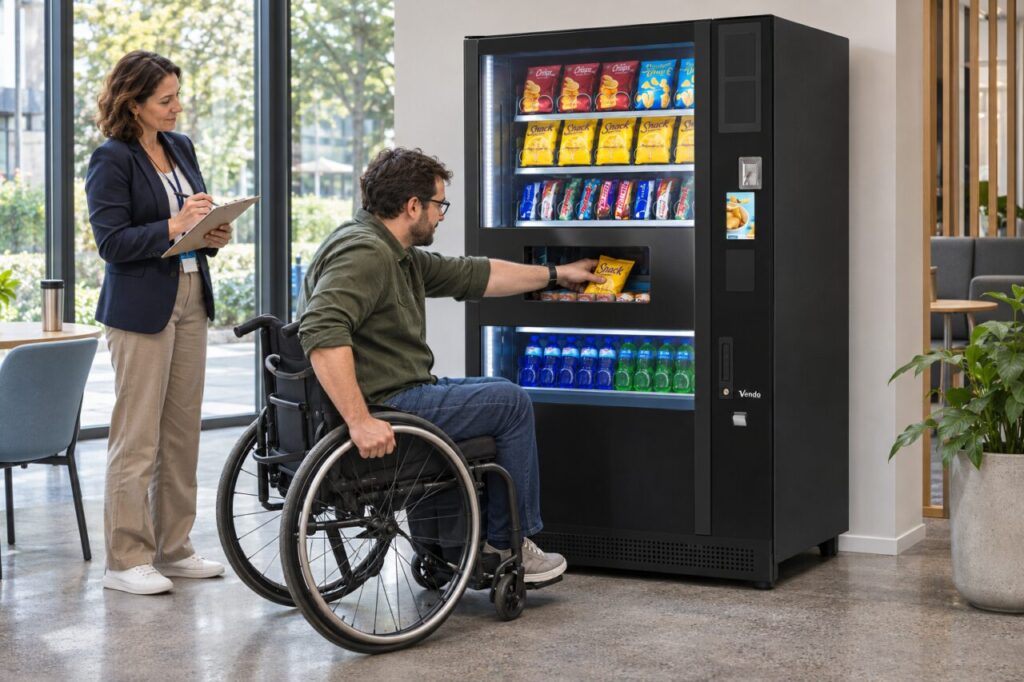
Test representative items, including the larger or less convenient packs that are genuinely in scope. Observe visibility into the collection area, access to the product and whether the person can bring it back safely. Do not encourage overreaching or repeat an uncomfortable action to complete a checklist. Stop the trial when the participant or assessor identifies a difficulty.
The SandenVendo AMX catalogue describes a central delivery opening. That feature is a reason to investigate a particular configuration, not evidence that it suits every customer or site. Pair catalogue information with the practical assessment and the supplier’s confirmation of the equipment being delivered.
Turn findings into an installation decision
Separate changes to the room from limitations of the machine. Moving a bin may solve an approach problem; it will not alter a collection mechanism. Ask the supplier and venue’s accessibility lead to review unresolved issues before placing the order. Agree an assistance route where needed, while being clear about which steps customers can complete independently.
When comparing vending equipment for an inclusive venue, include the trial findings in the specification and final handover. The delivery-planning guide covers the separate movement of equipment into the building. Once installed, repeat the agreed user checks in the real layout and keep the surrounding space clear as furniture and customer traffic change.