Vending Break-Even Changes with Product Mix: Use Contribution per Item Carefully
Two vending products can sell for the same amount yet contribute differently towards the costs of running the service. A break-even estimate based on one average item can therefore change when the product mix changes. Before converting a monthly cost into a target number of sales, check how the contribution figure was built.
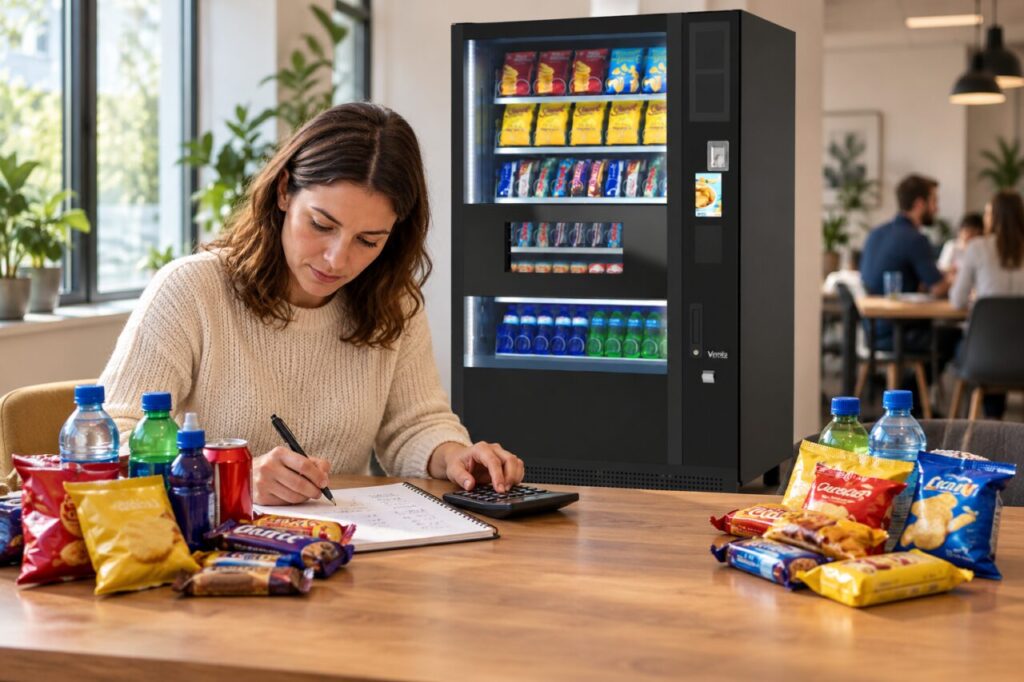
Contribution here means selling price less the variable costs included in the calculation. It is not the same as total profit. Equipment, service arrangements, site costs and other commitments still need to be covered. Use a consistent treatment of taxes and charges in your actual records and obtain appropriate accounting advice where the treatment is uncertain.
Calculate each product group first
For a deliberately simplified example, suppose a snack contributes €0.60 after its included variable costs, while a drink contributes €1.00. If you expect equal quantities of each, the average contribution is €0.80 per item. With €240 of other monthly costs included in this example, the mathematical break-even volume is 300 items.
These figures are invented for explanation and do not represent this company’s prices or expected earnings. A real calculation needs your actual selling prices, purchase costs, charges and service responsibilities. Do not substitute a percentage markup for contribution in euro. The target depends on the amount each sale leaves to meet the remaining costs.
Change the mix and recalculate
If snacks make up 75% of items and drinks 25%, average contribution becomes €0.70: three quarters of €0.60 plus one quarter of €1.00. Dividing €240 by €0.70 gives approximately 342.86 items, so a planning target using whole items rounds upward to 343. This is an estimate because the assumed mix may not occur exactly at that total.
If drinks instead make up 75%, average contribution becomes €0.90, giving approximately 266.67 items and a rounded target of 267. The equipment and monthly cost assumption have not changed; the mix has. This explains why copying another site’s item target can mislead even when both machines offer broadly similar snacks and drinks.
Check what the target leaves out
List the costs included in contribution and those included in the monthly commitment. Check for omissions and double counting. A charge deducted from each sale should not also be deducted in full as a fixed monthly amount unless the agreement genuinely has both parts. Stock write-offs and promotional items also need explicit treatment in the wider budget.
A break-even volume does not establish that enough customers will buy. Compare it with observed attendance, opening hours and actual purchase behaviour where available. Keep items separate from transactions: a customer buying two products may generate one or two payment events depending on the system, and the relevant fees must follow the real arrangement.
Review the mix after launch
Use recorded item quantities to calculate the achieved mix over a defined period. Keep unavailable selections and special events visible because they can distort what customers had the opportunity to choose. Do not remove popular low-contribution products solely to improve a spreadsheet average without considering the usefulness of the overall range and the site’s objectives.
When assessing a vending business, show a small range of mix assumptions rather than one guaranteed threshold. Explain the action each result suggests, such as reviewing costs or gathering better demand evidence. The useful outcome is a transparent decision about the service, not a claim that a calculated item count will inevitably be achieved.
For a proposal suited to your site, contact our team with the location, expected users and your main requirements.
Related guidance: Vending Break-Even Targets: Count Items Separately from Payment Transactions.