
What does a vending machine cost per day that your venue is open?
A venue open four days a week cannot spread its vending commitment across the same number of selling days as a site open continuously. To estimate a cost per open day, count the days on which customers can actually use the machine and divide the relevant cost for the same period by that count. Then check which costs continue while the doors are closed.
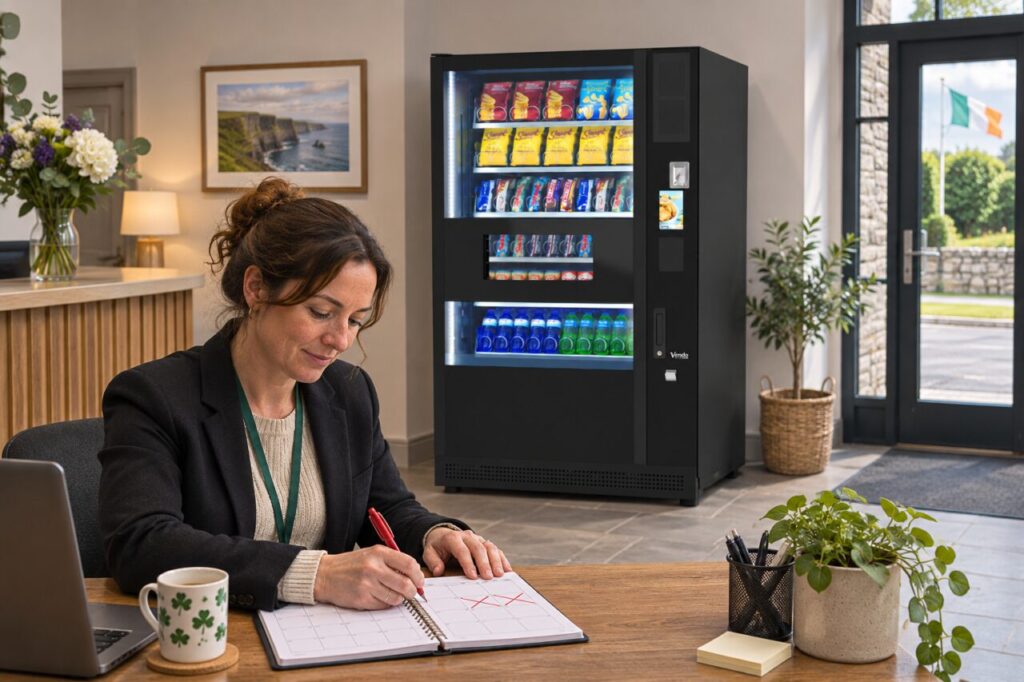
Define what counts as open
Start with the site calendar for the proposed month. Remove full closures, public holidays that the venue observes, and days when the machine’s room is locked. Include evenings or weekends if the public or staff genuinely have access. A building with a night security team may be occupied while the machine has no meaningful access for its intended customers.
Record partial days separately. Treating a two-hour training morning as equal to a full public trading day may distort the comparison. Where opening hours vary substantially, show the hours beside the day count or calculate a second figure per open hour. The point is to describe the sales opportunity sufficiently clearly for someone else to repeat your calculation.
Separate the costs that continue through closures
List the fixed commitment for the month, such as an agreed hire or service charge. Add only the other costs relevant to the question you are answering. Electricity may continue when the room is closed, while stock used in successful sales varies with purchases. Avoid assuming that a cabinet storing chilled food can simply be powered down to save money during a quiet day. Follow the equipment and food-management arrangements for the actual site.
In an invented example, suppose the fixed monthly commitment is €240 and customers can buy on sixteen days. That gives €15 per open day. If the same commitment applies in a month with twelve open days, the figure becomes €20. The invoice has not risen. There are fewer days on which the site can generate sales or provide the staff benefit it wanted.
Compare the daily cost with the right sales figure
Sales revenue is not the amount available to meet the fixed cost. Allow for the agreed product cost and other variable charges before comparing. Suppose a sale contributes €0.75 after those costs in a simplified example. Covering €15 would require twenty such sales on an open day. Covering €20 would require twenty-seven whole sales, because twenty-six would contribute only €19.50.
Use the actual mix of products for a real estimate. If workers buy lower-priced products on short days, the average contribution may also change. Show a range where evidence is limited. Our guide to cost per vending sale explores the related question from the transaction side.
Compare like periods before choosing equipment
Ask whether the site is buying a commercial return, a staff amenity or both. A quiet Friday might be worth serving even without enough sales to cover its share of a monthly fee. State who pays any shortfall and what availability they expect in return. Revisit the figures if opening days, occupancy or service scope changes.
Bring the actual operating calendar when using the vending machine cost guide. It gives the supplier a sounder basis for discussing ownership, hire or a managed arrangement than dividing an annual price by every day on the calendar.