
Vending Equipment Delivery: What to Do When the Site Address Has Two Entrances
A correct street address can still send a vending delivery to the wrong entrance. A site may have a public reception at the front and a goods entrance on another road, or several gates with similar names. Resolve that ambiguity before the equipment travels. The delivery instructions should identify the agreed receiving point without leaving the driver to work out the handling route on arrival.
Describe the arrival point precisely
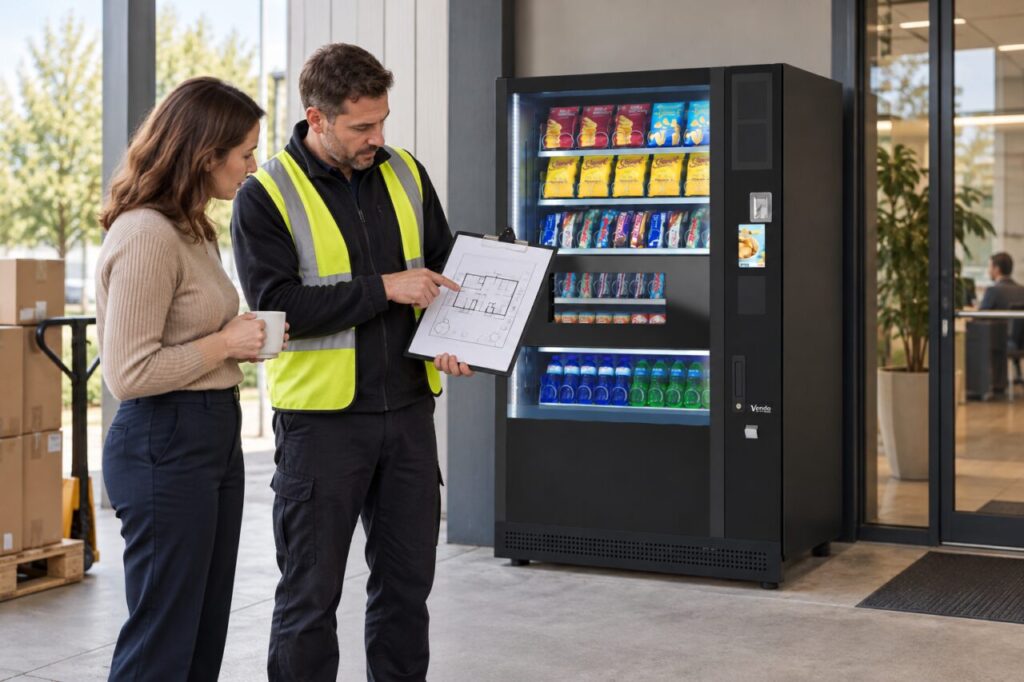
Start with the site’s official address and add the agreed entrance name, approach information and receiving contact. Where useful, provide a simple annotated site plan or a photograph of the entrance that the delivery team is authorised to use. Make sure the image reflects current conditions rather than an old layout or a gate that is now permanently closed.
When arranging vending equipment for an Irish site, tell the supplier about multiple entrances during the access assessment. Do not assume that the entrance nearest the final machine position is suitable for delivery. Vehicle access and equipment movement need to be assessed by the relevant professionals against the real route, not selected from a map alone.
Separate arrival from the internal route
The receiving point is only the beginning. Confirm who will meet the team and show them the approved route to the installation location. A reception desk may serve visitors well while offering no practical path for the equipment. The site contact should know which doors, lifts or shared areas have been agreed and which must not be used.
If security or reception needs advance notice, arrange it through the authorised site process. Keep private access codes out of public plans and general email attachments. A named receiving contact and clear arrival instruction are usually more useful than a long collection of building details that the driver cannot safely interpret while approaching an unfamiliar site.
Make inconsistent instructions easy to spot
Check the purchase order, delivery booking and supplier confirmation for conflicting entrance information. A common problem is a standard address automatically inserted into paperwork after a more specific receiving point has been agreed separately. Ask the supplier which instructions will actually be passed to the delivery team and ensure the current version is clearly identified.
For example, the invoice address might refer to headquarters while the machine belongs at another building. Keep billing details and physical delivery details distinct. If the equipment is part of a multi-site order, include a site identifier on the relevant paperwork. This reduces the chance that a correct machine is sent to the correct company but the wrong location.
Agree what happens if access differs
Give the team a clear escalation contact for a closed gate, occupied loading area or unexpected restriction. Do not tell them to improvise a different route. The supplier and responsible site contact should decide whether the approved plan can be adjusted safely or whether the appointment needs to change. Record any revised receiving point before directing the equipment there.
After delivery, keep the confirmed entrance information with the site equipment record and correct any misleading standard instructions. Future service visits may use a different route, so label the record accurately as a delivery arrangement rather than a permanent permission. A few precise details can prevent repeated arrival confusion without turning a simple visit into an unnecessarily complicated process for everyone involved.
Contact us with the proposed location and receiving arrangements to plan the next step.
Related guidance: Planning a Vending Delivery Around a Staff Shift Change.