Vending Margin and Markup Are Different: Compare Quotes Using the Same Calculation
Margin and markup describe the same difference between selling price and cost from different starting points. Confusing them can make two vending product proposals look more alike than they are. Label the calculation before comparing figures, and check which costs are included. A percentage without its basis is not a complete explanation of profitability.
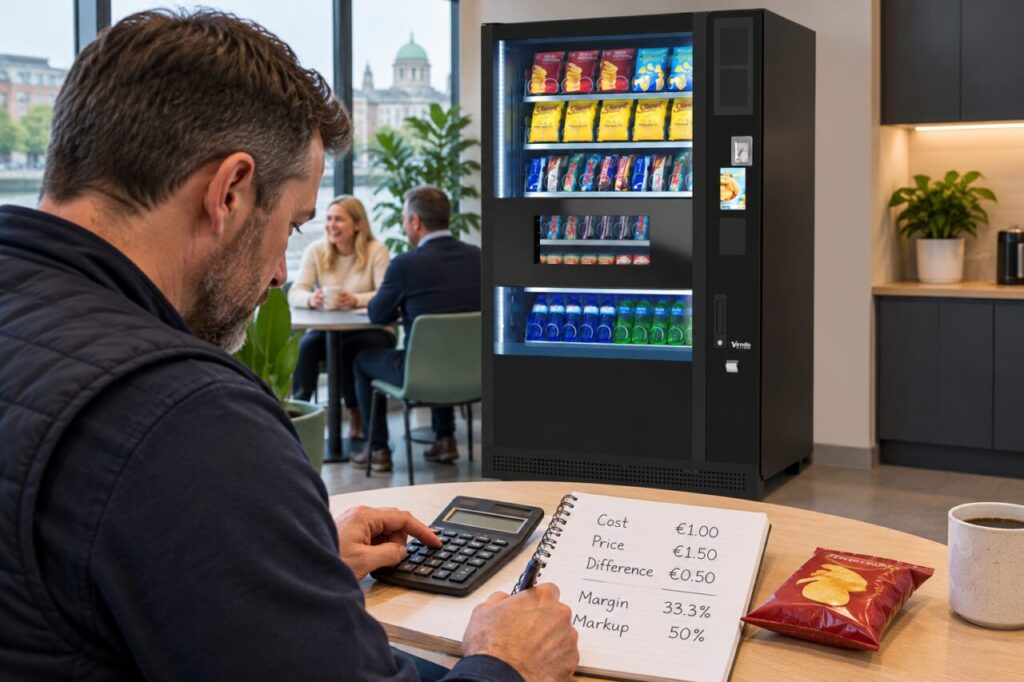
For a simple product comparison, the difference between selling price and product cost is the amount left before other costs considered outside that calculation. Margin expresses that difference as a share of selling price. Markup expresses it as a share of product cost. The denominator changes, so the resulting percentages are normally different.
Work through one illustrative product
Suppose a purely hypothetical product costs €1 and sells for €1.50, using figures on the same tax basis. The difference is €0.50. Dividing €0.50 by the €1.50 selling price gives a margin of about 33.3%. Dividing the same €0.50 by the €1 cost gives a markup of 50%.
Those figures describe one example, not a current vending price or a recommended return. They also do not establish net profit for the business. Payment costs, site charges, labour, waste and other expenses may still need to be considered. Keep the simple product calculation separate from a fuller assessment of the site’s operating result.
Check what a quoted percentage means
If a supplier or business proposal mentions a percentage, ask whether it means margin, markup, commission or another measure. Request the underlying cost and selling-price assumptions where appropriate. Do not compare a product markup with a site commission percentage as though both represent the amount retained from a sale; they may use different bases entirely.
Confirm whether discounts, delivery charges or other product-related costs are included in the cost figure. Keep tax treatment consistent and seek accounting advice where needed. A comparison mixing a tax-inclusive selling price with a cost prepared on a different basis can mislead, even when the arithmetic itself has been carried out correctly.
Use the right calculation for a target
Adding a stated percentage to cost produces a markup calculation. It does not automatically achieve the same percentage margin. In another illustrative example, adding 40% to a €1 cost gives a €1.40 price. The €0.40 difference is about 28.6% of that price, rather than a 40% margin.
For a target margin calculation, divide the relevant cost by one minus the target margin expressed as a decimal. A €1 cost and a 40% target margin produce approximately €1.67 before rounding. This is arithmetic, not a pricing recommendation. A vending business plan must also consider customers, competition and the actual operating costs.
Keep the comparison understandable
Label each worksheet column with the measure and basis used. Retain the underlying cost, price and unit quantity so another person can reproduce the result. If pack sizes differ, compare equivalent saleable units. Do not let a high percentage on a low-value item obscure the actual euro contribution or the number of units likely to sell.
Review the figures when purchase costs or selling prices change. Keep hypothetical examples separate from observed results, and do not present a target as achieved profit. A clear margin-and-markup distinction helps an operator ask better questions, compare proposals consistently and avoid making a pricing decision on a percentage whose meaning was never agreed.
Sage’s explanation of markup and margin uses cost as the basis for markup and selling price as the basis for margin. The worked figures here are illustrative calculations, not supplier quotations.
Related guidance: Vending Revenue Rose but Margin Fell: Compare the Product Mix.
For help assessing your site, contact Vending-Machines.ie.