
New Vending Equipment Still Has Protective Film: Confirm What Should Be Removed
Protective film on a newly delivered vending machine can look like ordinary packaging, but do not assume every clear covering should be peeled away. Ask the installer to identify what is temporary and what belongs to the finished equipment. The handover should leave the machine ready for normal use without damaging labels, controls or surfaces.
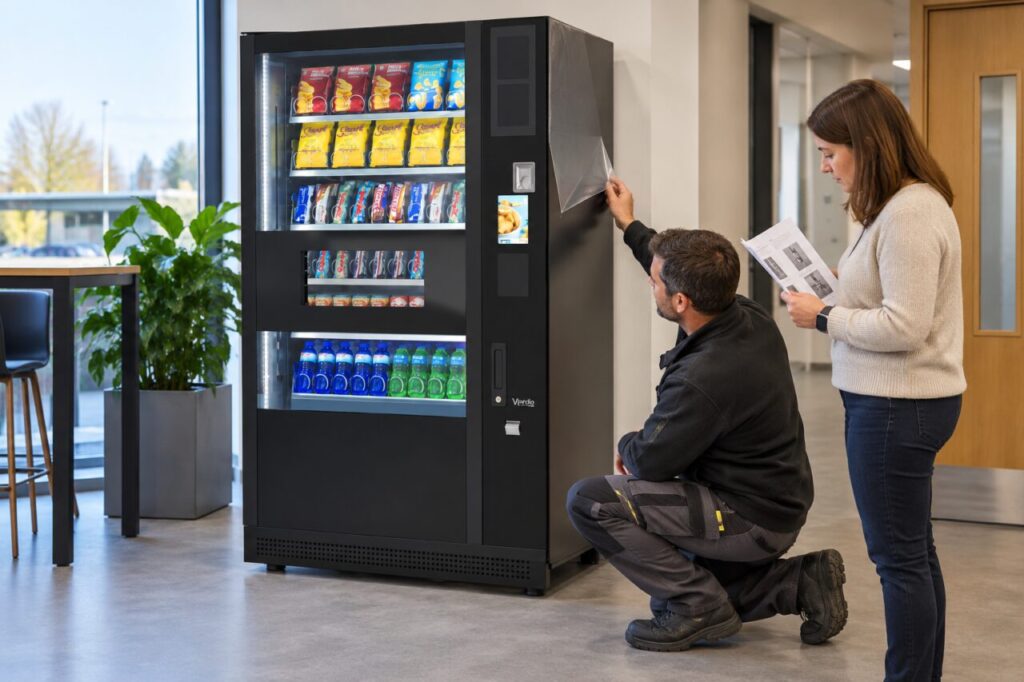
This is a small task that can become confusing when delivery and installation happen on different days. The person receiving the cabinet may not be the person commissioning it. Record any film left in place and who will deal with it, rather than leaving the first customer to investigate a loose corner.
Identify the covering before removing it
Have the installer compare the delivered unit with its installation instructions. Ask them to distinguish transport protection from permanent overlays, labels, seals and display components. A film-like surface around a control is not necessarily disposable packaging. If its purpose is uncertain, leave it undisturbed while the supplier confirms what it is.
Do not use a knife, scraper, solvent or heat to speed up removal without the manufacturer’s approved procedure. Those methods can turn a cosmetic task into damage to a finish or component. The venue’s role is to obtain a completed handover, not to experiment with materials on equipment it has just purchased.
Agree the sequence with the installer
Some protection may be retained while equipment is being moved through a building. Ask the installation team when removal belongs in their process and how the cabinet will be protected during any remaining work. Do not remove everything at the loading entrance simply to improve the appearance for a delivery photograph.
Once the unit is in its final position, ask for a visual check of the surfaces and customer-facing areas. Record any marks or residue through the agreed delivery reporting route. A photograph before and after the authorised removal can help establish what was present without making unsupported assumptions about when a mark occurred.
Keep labels and instructions readable
Check that the equipment identification, safety information and customer instructions remain intact and legible. Do not cover permanent information with a temporary welcome notice or use an unidentified label as a convenient peeling point. Ask the supplier to explain anything that appears damaged, missing or partly detached before the handover is closed.
Include the payment area, selection controls and collection opening in the readiness check. The installer should confirm that no loose packaging interferes with the intended customer journey. Staff should not insert tools into an opening to retrieve scraps; any inaccessible material should be handled through the approved installation or service process.
Close the task in the handover record
Dispose of removed packaging through the venue’s normal arrangements and leave the surrounding floor clear. Check nearby surfaces as well as the cabinet: a strip of film left on the floor can be overlooked once the machine is stocked and people begin using the area. Keep this task assigned until the installation team confirms completion.
If a covering must remain temporarily, record its purpose, removal owner and expected timing. Tell relevant staff so someone does not peel it off during cleaning or mistake it for unfinished damage. A clear handover answers three simple questions: what was removed, what remains intentionally, and who has confirmed that the equipment is ready for ordinary customers.
For help matching the service to your site, explore Vending-Machines.ie or send an enquiry describing your requirements.
Related guidance: Vending Delivery Packaging: Agree Who Removes It.