
Keep Vending Service Access Clear of Temporary Storage
The space beside a vending machine can gradually become a convenient place for spare cartons, delivery trolleys or cleaning supplies. What begins as temporary storage may interfere with the access agreed for servicing. Give those items another home and make the required clear area part of the site’s everyday arrangements.
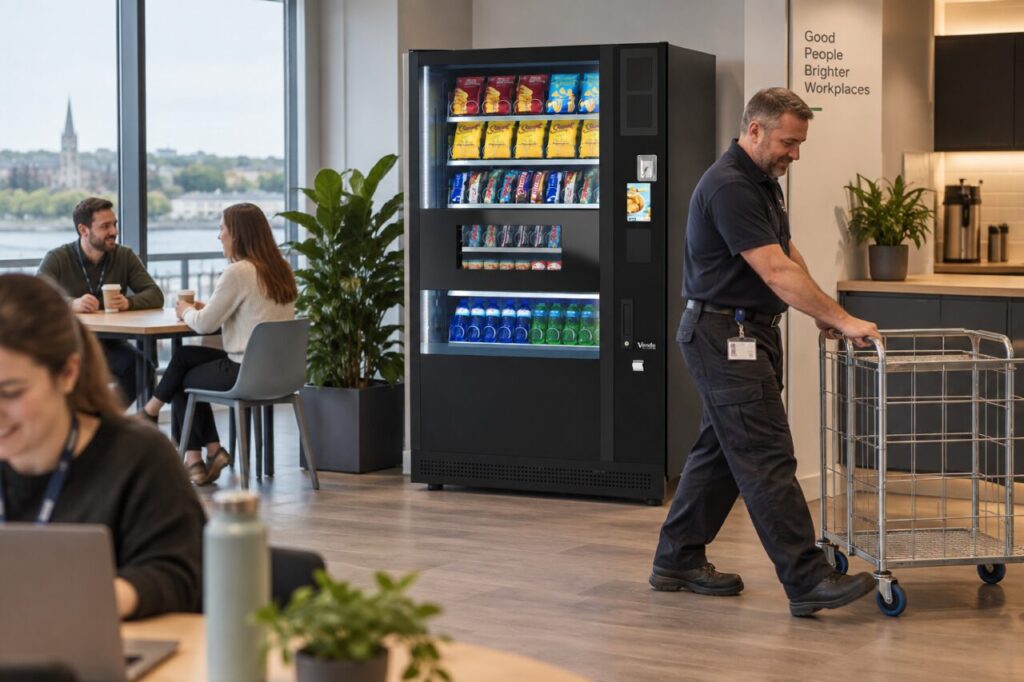
The necessary space depends on the machine and the work involved. Ask the supplier to identify the access and clearance requirements for your equipment. Do not estimate a universal distance from a photograph or move a heavy machine yourself to create more room when the original position becomes inconvenient.
Identify the access that must remain available
Walk the area with the responsible operator or supplier and clarify which parts must remain clear for customer use and service work. A site host may notice the front of the machine while overlooking the route used to bring stock or equipment to it. Record the supplier’s actual requirements in the site brief.
Connect this with the building’s existing access arrangements. Do not let vending storage encroach on routes or areas that the site requires to remain clear. Where there is uncertainty, ask the responsible facilities person to resolve it rather than treating the machine’s immediate footprint as the only space that matters.
Find an alternative for temporary items
Identify what repeatedly accumulates near the machine and why. If a trolley has no assigned parking place, asking staff to move it once is unlikely to solve the underlying problem. Agree a practical storage location with the team that uses it, taking account of the building’s own rules and available space.
Keep replenishment stock in its appropriate storage arrangement rather than using the service area as an unofficial stockroom. The operator should know where authorised stock is held and how to access it. Avoid creating a new obstruction elsewhere by simply moving everything around the nearest corner without discussing the route.
Make responsibility visible
Assign a role to check readiness before a planned service visit. This person does not need to perform technical work; they need to confirm that the agreed site arrangements are in place. Include the check in the visit coordination process so it is not dependent on a particular colleague remembering every time.
Use a clear internal instruction where repeated confusion occurs. Explain which items should not be left in the area and where they should go instead. Keep public notices proportionate: customers should still be able to find normal machine instructions without being surrounded by unrelated operational reminders intended for staff.
Respond to recurring obstructions
If the same issue returns, review the layout and workflow with the relevant teams. A new delivery pattern, contractor or room use may have changed how the area functions. Ask the supplier whether the current arrangement still supports servicing; do not assume that the original survey covers every later change in the room.
Record any agreed adjustment and share it with the people who use the space. After the next service visit, check whether the revised arrangement worked. A useful outcome is a clear route and a practical home for equipment, rather than a record saying the area was cleared once while the daily problem continues.
When planning vending for an Irish workplace, discuss service access alongside customer access. The restocking contact-cover guide addresses who coordinates a visit; keeping temporary storage out of the way helps that contact provide the physical access the operator actually needs on arrival.
Request a site discussion if changing room use is affecting your vending arrangement.