
One vending snack, two portions? How to read the packet
If a vending snack shows a number per portion, first check how many portions the packet contains. The amount on the front can describe half the bag even though you buy the bag in a single transaction. Two different questions are worth asking. How do these snacks compare at the same weight? And how much of a particular nutrient is in the amount I expect to eat?
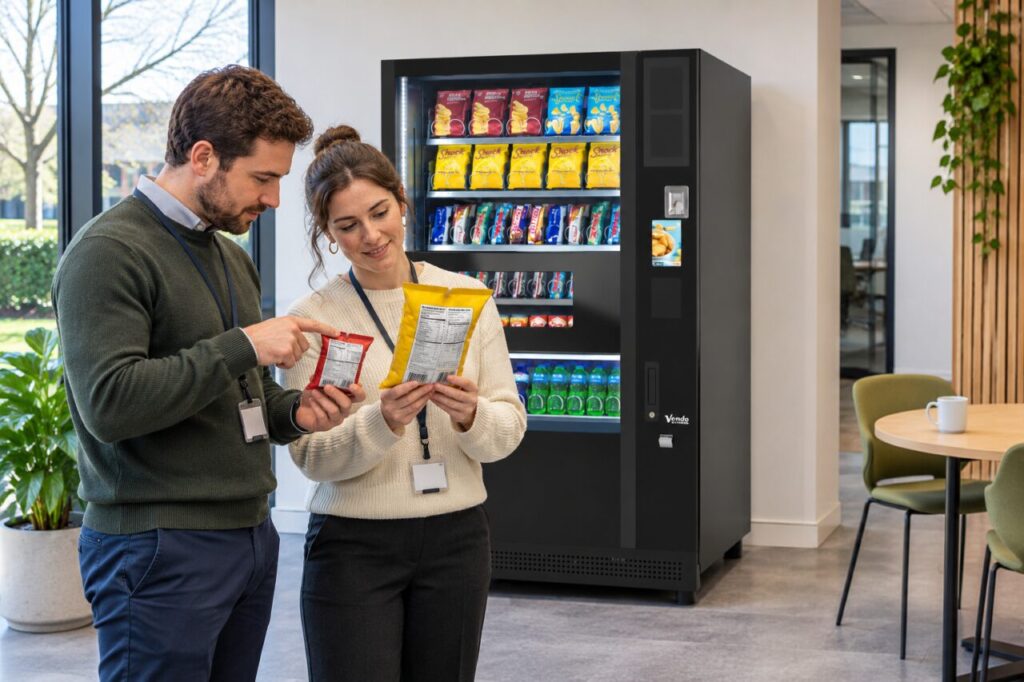
Use a common weight to compare recipes
For prepacked foods carrying a nutrition declaration, the standard per-100 g or per-100 ml figure gives a common basis for comparison. Figures per portion can also appear. The Food Safety Authority of Ireland explains these conventions in its nutrition labelling guidance. Check the column heading as well as the number. A smaller figure can simply reflect a smaller stated portion.
Imagine two savoury snacks. Packet A shows 1.2 g of salt per 100 g, while packet B shows 1.0 g per 100 g. B has less salt for the same weight. That comparison alone does not tell you which whole packet contains less. For that you also need the weight of each pack and the amount you will actually eat.
Calculate the figure for the whole packet
Suppose A weighs 25 g and B weighs 50 g. For A, multiply 1.2 by 25 and divide by 100. The packet contains 0.30 g of salt. For B, the corresponding calculation is 1.0 times 50 divided by 100, giving 0.50 g. These are invented labels to illustrate the arithmetic. The snack with the lower figure per 100 g has the higher figure per whole pack in this example.
If B describes 25 g as one portion, a single portion contains 0.25 g of salt. Eating the whole packet means eating two such portions. If you plan to share it, divide according to what each person actually takes. A stated portion is useful information for a calculation. It is not a measurement of an individual’s appetite or a prescription for their diet.
Read the right line for the question
Compare sugars with sugars and salt with salt. If you want to compare energy, keep both figures in the same unit. A label can give energy in kilojoules and kilocalories side by side, so a misplaced column can produce an enormous apparent difference. Use the current pack because a similar flavour or a later pack design can carry different information.
Workplace buyers can apply the same approach when discussing a new range. Ask the supplier for the label for the precise pack offered. A supermarket family bag with a familiar brand name is not necessarily the product that will be loaded. Our guide to trialling two pack sizes shows how the buying occasion can influence a choice.
Make the range understandable at the machine
Ask whether staff can identify the size of the pack before purchase and where they can find current label information. If two versions sit next to each other, give them distinct descriptions. Keep comparisons specific to the product and portion being discussed. One number cannot establish that a snack is the best choice for everyone.
When reviewing snack vending options, bring examples of the products people want and the sizes they expect to buy. That gives the operator a more useful brief than a request for a bigger or healthier range with no further detail.