
Should you buy a second-hand vending machine for spare parts?
A cheap second-hand cabinet can be an expensive way to obtain one spare part. Before buying a donor vending machine, identify the precise component your operating cabinet needs and ask a qualified service provider whether recovery, testing and installation make sense. The value is the usable, compatible part you can obtain, rather than the number of components visible through the donor’s door.
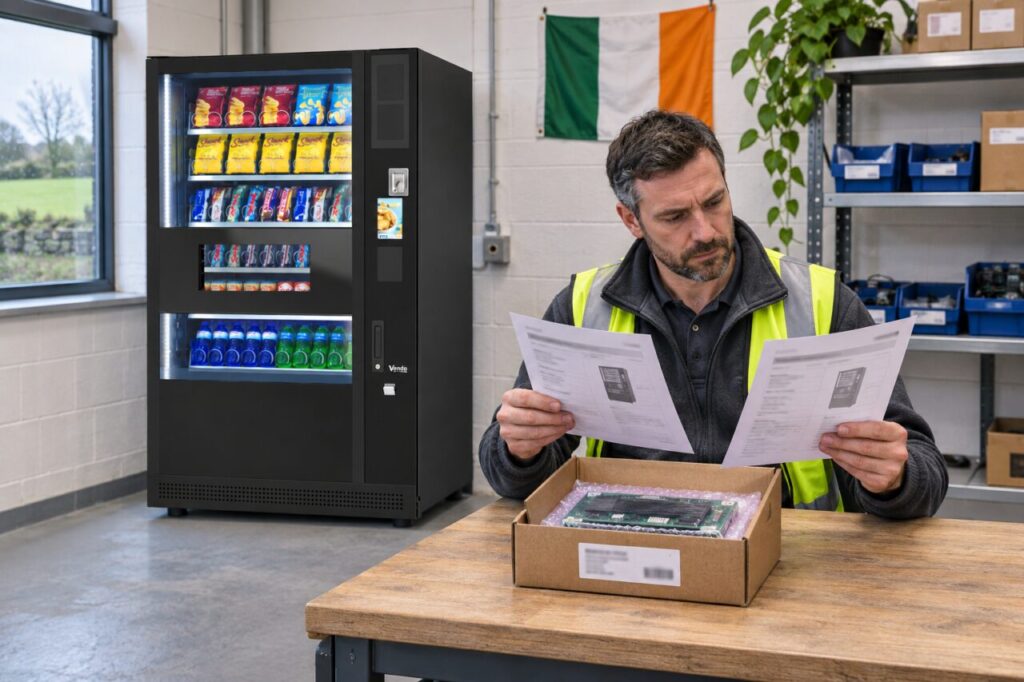
Start with the machine you need to repair
Record its model, serial number, configuration and the fault the technician has assessed. Ask for the required part reference and any relevant revision details. Two machines sold under a similar model name may have different equipment. A matching front panel or a seller’s assurance that the machines look identical does not establish interchangeability. Use manufacturer information or a service provider able to verify the match.
Now request the same identification for the proposed donor. Ask whether the component is physically present and whether it has been tested. A cabinet described as ‘for parts’ may already have had the desirable item removed. If the seller cannot establish condition, treat the part as untested when comparing options. Our guide to production versions explains why the identification record matters.
Put recovery and testing into the price
List the cabinet purchase, collection, transport, secure storage, professional recovery, testing and installation. Add the cost of responsibly dealing with the remaining cabinet. Ask who is qualified to do each task. Do not attempt to dismantle refrigeration or electrical assemblies to establish whether a speculative purchase might pay off. The equipment service guide explains the role of qualified personnel and model-specific procedures.
For an invented comparison, suppose the donor costs €150, collection costs €110 and recovery and testing cost €140. That is €400 before installation, storage or disposal. A separately sourced tested spare quoted at €360 could cost less overall even though its individual price is much higher than the donor cabinet’s asking price. Compare both offers at the same stage, with any delivery, fitting and support treated consistently.
Ask what happens if the recovered part fails
Find out what the seller will confirm about the donor and what the service provider will confirm about the recovered part. Those are separate commitments. Ask whether the service provider is willing to fit a used component, what evidence they require and what would happen if the component proved unsuitable on inspection. Leave an unresolved cost visible instead of entering a saving you have not earned.
If several other parts appear useful, list each one against an actual machine you maintain and a verified compatible reference. Do not split the purchase price evenly across ten possible spares when only one has a known use. A store full of unidentified components creates work at the next repair and can delay the order for the correct part.
Make a decision before committing transport
Request a written comparison for the donor route and a supported spare. Include lead time and what happens to the operating machine while the part is assessed. If the donor cannot be verified, you can still choose to carry the risk, but the budget should show what happens if the recovered part has no usable value.
When comparing vending machines to buy, keep repair planning separate from bargain hunting. A verified part number, a technician prepared to use it and an agreed method of testing are stronger reasons to buy than a low price for a whole cabinet.