Condensation Obscures the Vending Glass: What Customers and Site Staff Should Record
Misted vending glass makes it harder to identify products and read information. Customers should not guess what is behind an obscured section, and site staff should not assume the appearance proves either a harmless condition or a refrigeration fault. Record what is visible and ask the responsible operator to assess the equipment and any affected stock.
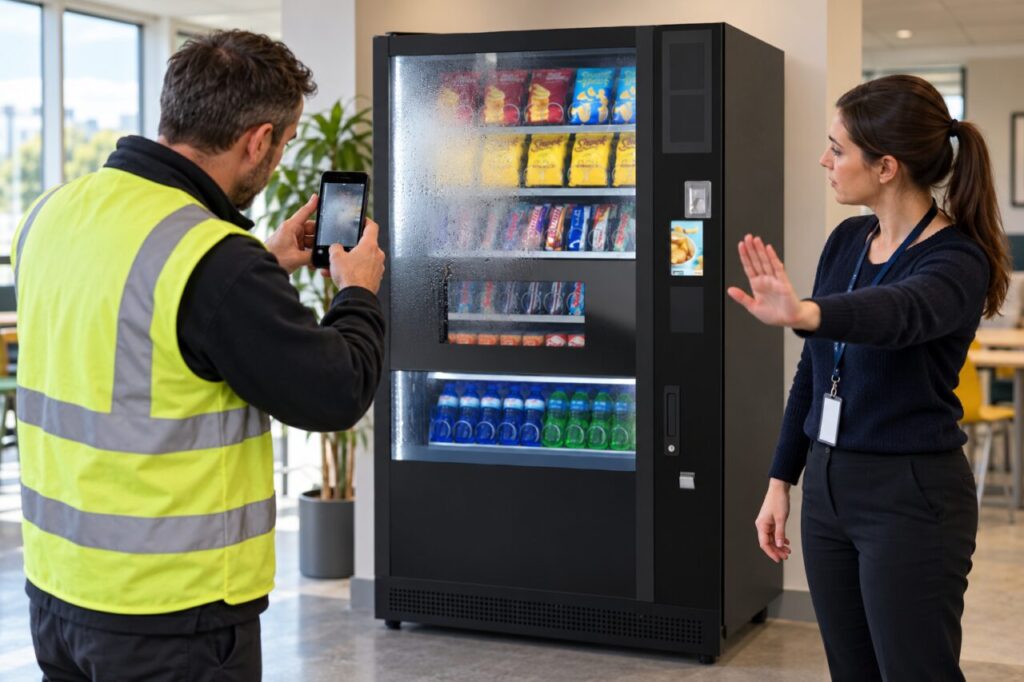
Keep the report observational. Explain where the misting appears, when it was noticed and whether there are other visible signs such as droplets or water nearby. Do not open the cabinet, adjust temperature settings or apply heat to clear the view. Those actions can change the situation before the responsible person has assessed it.
Describe the affected area clearly
Identify the machine location and the part of the glass that is obscured. Note whether product information, selection labels or the collection area can still be seen. A photograph from outside can provide useful context, provided it does not capture customers’ payment details or unnecessary personal information. Include an overall view as well as the affected area if practical.
Do not claim the moisture is inside or outside unless that is genuinely clear without intervention. A photograph alone may not establish the cause. State uncertainty explicitly and let the operator decide what further observation is appropriate. Avoid wiping, spraying or testing the surface merely to improve the description unless you are authorised and following the relevant instructions.
Keep customers from guessing
If the product cannot be identified or necessary information cannot be read, advise customers to ask for help or choose an available alternative rather than make an uncertain purchase. Do not reassure them about the condition of food based solely on the machine’s appearance. Product suitability and equipment performance need the responsible operator’s assessment and records.
Where water is visible around the machine, alert site staff and use the site’s procedure for protecting the surrounding area. Keep customers away from an apparent hazard. Do not reach towards electrical components or move the equipment to investigate. Any technical inspection or isolation belongs with an appropriately authorised person using the site’s agreed safety arrangements.
Add relevant context without diagnosing
Tell the operator about known events close to the observation, such as a recent refill, a room-temperature change or a nearby door being left open. These are pieces of context, not a diagnosis. Keep the time and source of each observation clear. A colleague’s recollection should not become a precise event time unless the record supports it.
Ask whether the machine should remain available while the report is reviewed and who will communicate the decision. If stock requires assessment, leave that with the responsible food-business operator. Do not reset a display, change a setting or move products to another location merely to make the machine appear normal before the review.
Record the assessed outcome
After authorised attention, obtain a clear customer-facing status: available, restricted or awaiting further work. Keep any stock decision and service follow-up recorded with the original report. If the misting clears before the visit, retain the photograph and timing rather than closing the issue on the assumption that disappearance proves there was no underlying problem.
When discussing vending installation and service, ask how the operator wants site observations reported and which routine tasks staff may perform. Clear boundaries help staff provide useful evidence without improvising maintenance. The aim is a readable customer display, an assessed equipment condition and a traceable response when the same observation appears again.
For a proposal suited to your site, contact our team with the location, expected users and your main requirements.
Related guidance: Vending Near Automatic Doors: Check the Draught and Customer Waiting Space.