
Free Units in a Vending Stock Order: Count Them Without Hiding the Purchase Cost
A supplier promotion that includes free units can improve the value of a vending stock order, but only if the records show what actually arrived and what was paid. Recording the paid cases while overlooking the bonus stock understates available units. Treating the whole delivery as free understates the purchase cost. Keep both quantities and money visible, then decide whether the offer remains useful after considering the products you can realistically sell.
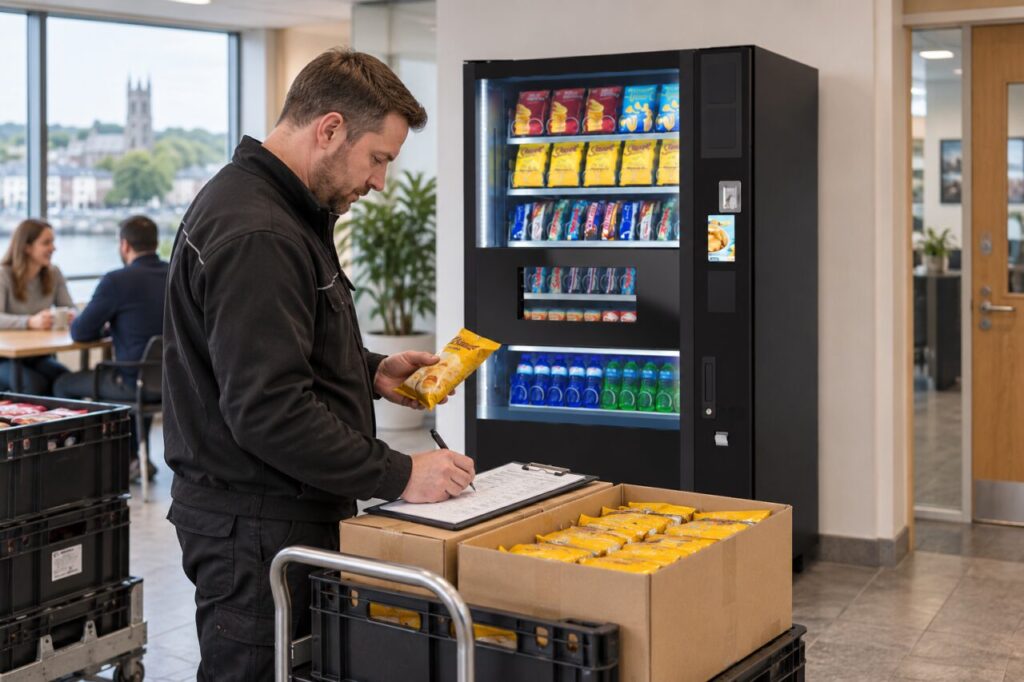
Count the complete delivery
Check paid and promotional quantities against the order and delivery paperwork. Count saleable units rather than relying only on the number of outer cases. Confirm that the bonus product is the same pack size and product you expected. A free case of a different flavour should remain separately identifiable rather than being merged into another product’s stock balance for convenience.
Record shortages or damaged packs through the usual receiving process. A promotional label does not remove the need to inspect the delivery. If the free units are due in a later shipment, keep them outstanding rather than recording them as physically available. This distinction matters when the next refill is planned: stock promised by a supplier cannot be loaded into a machine today.
Work through a simple unit-cost example
For illustration, imagine paying €48 for forty-eight units and receiving twelve additional identical saleable units at no extra product charge. The delivery contains sixty units. Dividing €48 by sixty gives an average product purchase cost of €0.80 per unit for that delivery. This example assumes no additional charges and ignores tax treatment; it is arithmetic for comparing stock offers, not an accounting instruction.
Keep the original invoice and the promotional terms alongside the calculation. If delivery charges or other costs are relevant to your comparison, show them explicitly. Do not rewrite the supplier’s invoice or describe the bonus units as a cash rebate. Your bookkeeping process should determine how the transaction is recorded formally, while the operational stock record must still show the actual units received.
Check whether the extra stock is useful
Compare the total delivery with likely sales, available storage and the product’s dates. Extra units do not automatically make an offer economical if they cannot be used appropriately. Ask whether the promotion commits you to a quantity or product mix you would not otherwise buy. A smaller ordinary order may fit a quiet site better than a larger discounted delivery.
Consider where the bonus units will go before allocating them across machines. If they are a new product, confirm equipment suitability and range approval through the normal process. Do not introduce an untested pack merely because it arrived free. Keep stock transfers and trial usage recorded so that the eventual sales review reflects the full quantity introduced, not only the cases paid for.
Avoid carrying a temporary cost forward
Label the calculated cost as specific to that promotion. When preparing a future budget, check whether the offer will still apply. A margin forecast based on a one-off bonus can overstate the result of later standard-price orders. Compare both cases if the promotion’s continuation is uncertain, and make the assumption visible to anyone reviewing the figures.
Use this discipline within your vending business planning. A worthwhile offer should be understandable in units, cash paid and practical use. Accurate receiving records and a clearly limited cost calculation let you assess the benefit without confusing promotional stock with extra sales, missing inventory or a permanent reduction in your normal operating cost.
Discuss equipment and stock planning for your vending business.
Related guidance: Vending Stock Case Discounts: Compare Savings with the Quantity You Can Use.