
Vending Stock Case Discounts: Compare Savings with the Quantity You Can Use
A larger vending stock order can have a lower price per item while still being a poor fit for the business. The useful comparison is between the quantities you can realistically use, the complete purchase cost and the alternatives available. A headline case discount should not replace that assessment. Start from your own stock and sales records, and keep assumptions visible where demand is uncertain.
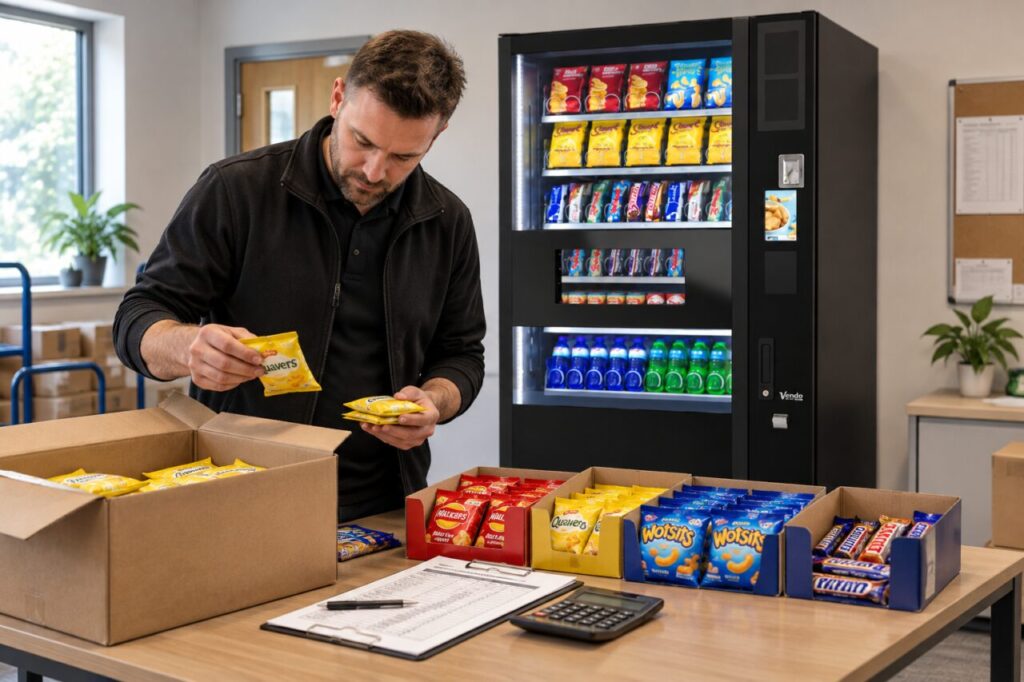
Put the offers on the same basis
Identify the exact product and saleable pack size in each offer. Confirm how many individual units are in a case and whether quoted prices use the same tax basis. Include applicable delivery or handling charges when comparing the cash required. Do not compare a mixed case with a single-flavour case as though they provide the same range without checking the contents.
Use a simple hypothetical calculation to understand the distinction. If one offer costs €24 for 24 units, its purchase cost is €1 per unit. Another at €45 for 50 units is €0.90 per unit before any additional charges. Those invented figures illustrate arithmetic only; they are not supplier prices. The second order uses more cash and brings more stock, even though its unit price is lower.
Check the quantity against your own operation
Look at the stock already held, stock allocated to upcoming refills and ordinary sales over comparable periods. Account for days when the product was unavailable before treating low sales as low demand. Avoid turning a recent event spike into a permanent forecast. If the evidence is limited, use a cautious range of possible usage rather than one apparently precise prediction.
Confirm the product information and storage requirements with the supplier, including the dates on the actual stock offered. Do not assume every discounted case has the same usable period as a previous delivery. Ask the responsible food-business team to assess handling and suitability under its established procedures. A financial comparison cannot establish that a product is appropriate to store or sell.
Compare alternatives to the large order
Ask whether smaller quantities, a different delivery frequency or a mixed order would better match the range. Compare the whole arrangement rather than only the individual item price. An offer that helps one product can crowd out purchasing capacity for other products customers expect to find. Keep the decision connected to the complete machine range and available storage.
Avoid justifying the order with sales you have not evidenced. A lower purchase price does not automatically create additional customer demand. If you intend to trial a larger allocation, define the trial and its review point separately. The purchasing decision should remain understandable even if the hoped-for increase does not occur.
Record the decision and review the outcome
Write down the chosen quantity, the comparison basis and the demand assumption used. After the relevant period, compare actual use with that assumption and record any remaining stock. Keep the review factual: a sensible decision can still meet changed circumstances, while a lucky result does not prove an unsupported forecast was reliable.
For broader planning, our vending business guide is a starting point. Build purchasing habits around clear quantities, current supplier information and your own operating records. The objective is stock that serves customers at an understood cost, not winning the largest possible discount on a product you cannot use effectively.
Discuss your intended product range through our enquiry page.
Related guidance: Vending Snack Ranges: Test Whether Small Packs Fill a Different Need.