
Two Micro-Market Customers Share a Checkout: Keep Their Baskets Separate
Two colleagues reach a micro-market checkout together and begin handling their snacks at the same time. A shared counter does not necessarily mean a shared purchase. Before either customer pays, establish whose items belong in the current basket and whether the checkout clearly shows the intended transaction.
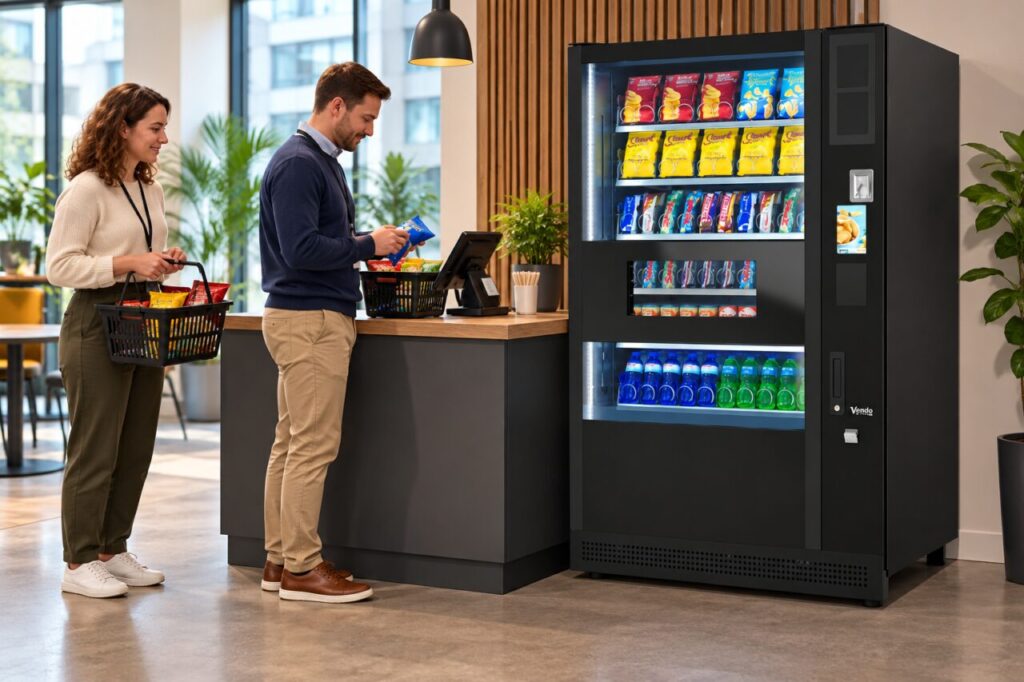
The practical aim is to avoid a mixed purchase that later needs an explanation or correction. Follow the instructions for the installed checkout and ask the operator about its supported workflow. Do not assume every system can split a payment, transfer an item between baskets or undo a completed transaction in the same way.
Keep the physical baskets distinguishable
Leave enough counter space for one person’s items to remain separate from the next customer’s selection. Two identical packets placed together are especially easy to confuse. Customers can keep their own items in a basket or a clearly separate area while the first purchase is completed, provided that arrangement suits the site’s checkout layout.
Avoid moving the next person’s products into the active scanning area to speed things up. A small queue is easier to manage than an uncertain transaction. If the counter is too cramped for separate waiting items, review the layout with the operator rather than improvising an obstacle that makes access more difficult.
Check the displayed basket before payment
The person paying should review the products and quantities shown by the checkout, where that review is available. Match the entries to their own items, not simply to everything on the counter. A total that looks plausible can still contain one colleague’s snack and omit another person’s drink.
If something appears wrong, pause and use the supported correction process. Do not continue pressing controls in the hope that another screen will separate the purchases automatically. An operator-approved help instruction should explain what the customer can do and when assistance is needed before payment is attempted.
Give the next customer a clear start
After the first transaction, confirm that the checkout is ready for a new purchase using its normal on-screen indication. Removing the first customer’s items from the counter can help make the changeover clearer. Do not infer that a transaction has ended merely because a bank notification appears or a customer walks away.
The site’s instructions should explain the ordinary end-of-purchase sequence without requiring customers to understand the underlying software. Test those instructions with two people using the actual setup. Observe whether the second customer can identify when to begin and whether any item or receipt from the first purchase causes confusion.
Decide how shared purchases will be handled
Sometimes one colleague intentionally pays for both people. That can be treated as one agreed purchase if the checkout supports the normal transaction, but it should be a conscious decision. It is different from accidentally combining baskets and deciding afterwards that somebody else can sort out the money.
Where staff allowances or other benefits apply, ask the operator how the system handles eligible purchases. Do not promise that one person’s entitlement can be shared, divided or transferred. Keep any private repayment between colleagues distinct from the operator’s sales record and the checkout’s supported account arrangements.
Record problems with useful detail
If a mixed basket is discovered later, note the location, approximate time and the items each person intended to buy. Follow the site’s approved support route and share only the transaction information requested. Avoid sending complete card details or unrelated personal account screenshots as evidence of a simple basket query.
When comparing micro-markets and vending, include checkout clarity in the discussion. A short two-customer trial can reveal whether the proposed counter, instructions and support process work together. Review the result before introducing extra prompts that may make a straightforward purchase harder to follow.
Related guidance: read Micro-Market Collection Space: Keep Paid Items and Shopping Baskets Clear for the connected question.
Describe your checkout space and customer flow in an enquiry.