
Who takes the remaining snacks when a vending machine changes owner?
When a vending machine is sold with snacks still inside, agree whether the sale includes the cabinet, the stock, or both. An apparently full display is a poor way to value the goods. Some selections may contain only one pack, others may contain different products behind the front item, and some items may need to be removed before either party takes responsibility.
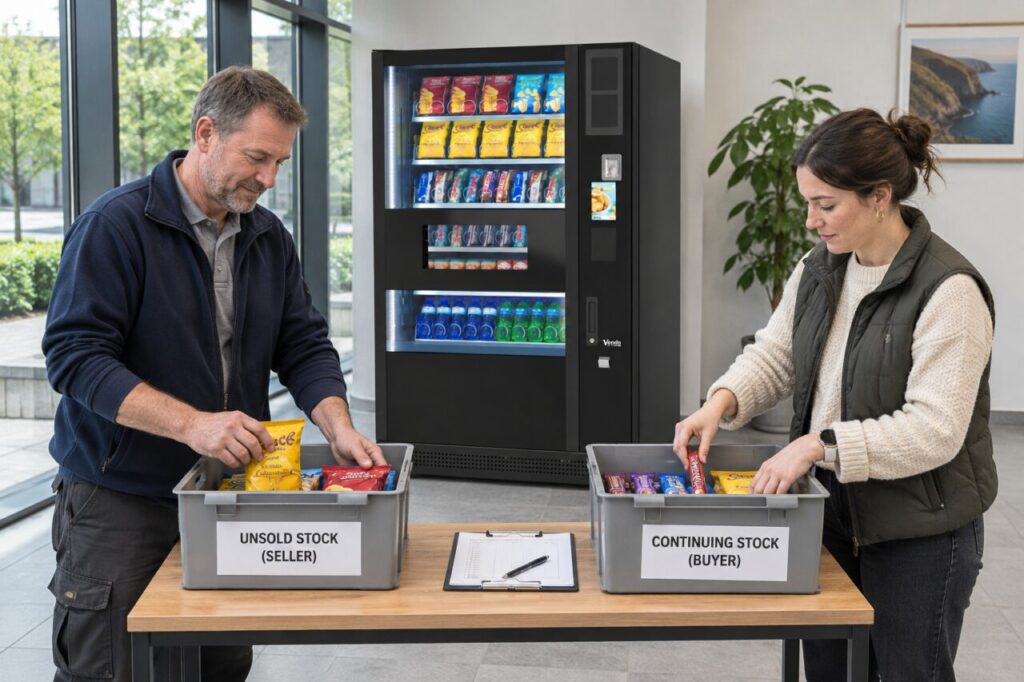
Choose a cut-off time both parties can use
Pick an agreed time for the stock count and decide who controls sales during it. An operator can suspend trading through their normal authorised process, or both parties can reconcile any intervening sales against the final count. Avoid one person counting on Friday afternoon while the other assumes that nothing has sold by Monday morning. Include the machine reference, site and time on the handover sheet.
Separate items inside the machine from reserve cases in the store. Check who owns each quantity. A site might hold goods supplied by somebody other than the person selling the cabinet. An invoice for equipment alone does not establish that the seller can transfer every case sitting nearby. Ask the relevant owner to confirm the arrangement before including those cases in the price.
Count saleable packs, then agree a value
Have the authorised operator identify the products and count the individual units being offered. Record pack size and date information as well as the product name. A case price applies to a particular number of units. If a case of twenty-four has eleven packs left, use the agreed unit valuation for eleven packs. Do not silently value an open case as a full one.
Keep damaged packs, short-dated lines and goods requiring investigation on separate rows. Agree which the outgoing operator will remove and who records the disposition. It can be sensible to accept a smaller quantity than the shelves contain if the incoming range will change immediately. A stock handover does not require the buyer to sell a product simply because it came with the machine.
Keep the evidence that follows the food
The Food Safety Authority of Ireland explains that a food business needs to identify its supplier and, when it supplies another food business, the recipient. Its traceability guidance explains why those records matter during a recall. Ask for enough information to connect the transferred packs with the source records. Keep lot details where applicable.
If chilled goods are involved, establish how their storage conditions have been maintained and what happens during the transfer. A count sheet on its own gives no assurance about temperature history. Refer uncertain items to the responsible food business before making them available for purchase. Do not combine them with accepted stock merely to make the totals agree.
Close the sale with two separate totals
Write one amount for the cabinet and another for the accepted stock. Note anything the seller will collect later, the collection deadline and the contact who can grant access. Have both parties retain a copy. The incoming operator can then use the accepted quantities as the opening stock record without treating a transfer as a refill or a sale to a customer.
Read the used equipment identification guide when matching that paperwork to the cabinet. If you are comparing vending machines for a workplace, ask for the opening range to be itemised even when the supplier offers a single package price.