
Will a small vending machine hold enough of your best-selling snack?
A site selling only six varieties of snack does not necessarily need a small machine. What matters is how many units of each variety the cabinet can hold and how many customers will want them before the next refill. A compact machine can be a good fit for a narrow range, but a small number of product names does not guarantee enough space for the busiest line.
Start with the product that runs out
Suppose the workplace buys twelve packets of its favourite snack on a normal day and receives a refill every three trading days. On that illustrative pattern, thirty-six packets are needed between refills before any allowance for variation. If the proposed layout gives that product space for eighteen, the fact that other rows are still full on day three will not help a customer looking for the favourite.
Ask the supplier how many of your actual packets fit in the proposed positions. The figure should come from the pack shape and configured layout, not just a cabinet’s maximum advertised capacity. If the supplier offers two positions for the same snack, ask whether customers can easily find the second one when the first sells out. Check the complete selection and collection process with sample packs.
Decide what the compact layout would displace
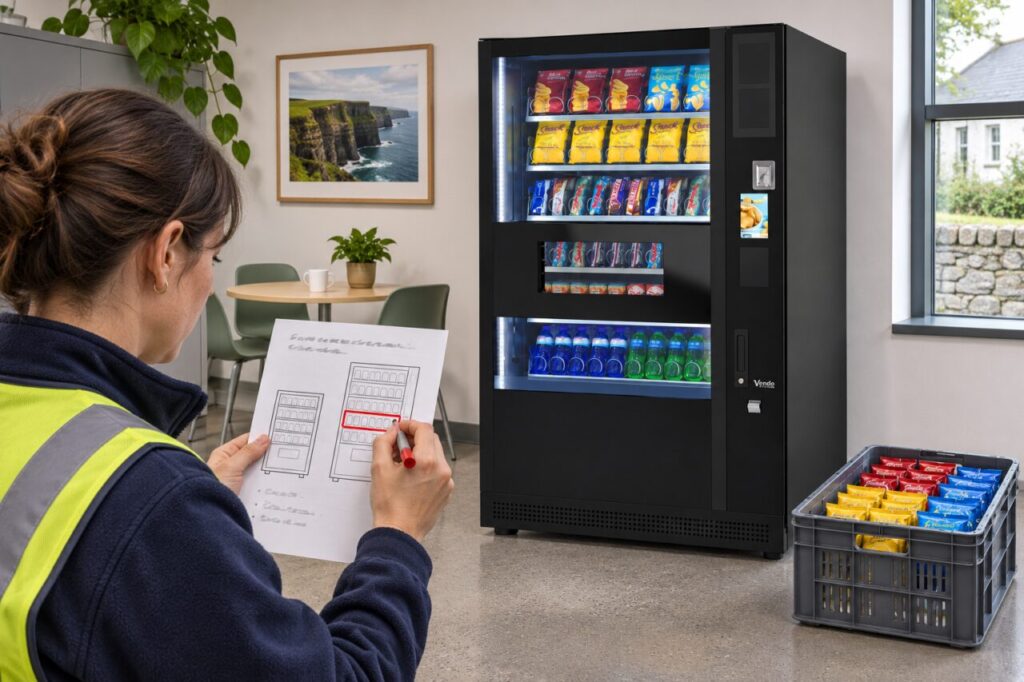
Give each proposed product a row on a simple sketch. Enter the usable quantity and expected demand between visits. Adding another position for the favourite may remove the only space for a less popular but important choice. Ask staff whether that lost option matters, especially if it serves a different break, price point or preference. A tidy plan with fewer empty slots can still disappoint regular customers.
Look at a larger layout alongside the compact one using the same stock list. Extra capacity has value when it solves a specific shortage or reduces an otherwise necessary refill. It also needs space and stock. Do not fill unused positions with slow-moving products merely to make the larger machine appear fully used. Our guide to sales and display space explains how to assess that trade-off.
Compare a change in visit frequency
If the smaller cabinet needs an extra weekly visit, identify who will make it and how much time it takes. Include access to reserve stock and the period when staff can refill. An operator already visiting the same room for another purpose faces a different decision from one making a dedicated journey. Ask for the actual service arrangement before turning that extra visit into a cost estimate.
Run the calculation once for a normal week and once for a known busy interval. A training day or evening event can move demand without changing the number of desks in the building. Decide whether temporary extra stock, an adjusted visit or a different cabinet is the most practical response.
Ask where the remainder of an opened case will go. A cabinet taking eighteen packets from a case of twenty-four leaves six to identify, store and bring to the next refill. Include that handling in the comparison.
Request two layouts rather than two headline capacities
When considering compact vending options, send the supplier your packs, refill interval and usable space. Ask for a small and a larger layout with the limiting product highlighted on each. Choose the machine that keeps the agreed range available with a refill routine your site can actually sustain.