
A Vending Cleaning Log Has an Empty Entry: Establish What Happened Before Signing
A vending cleaning checklist contains an empty row for yesterday’s shift. That tells you the record is incomplete; it does not, by itself, prove whether the work was missed. Before somebody signs the gap, establish what can be confirmed and what action is needed now.
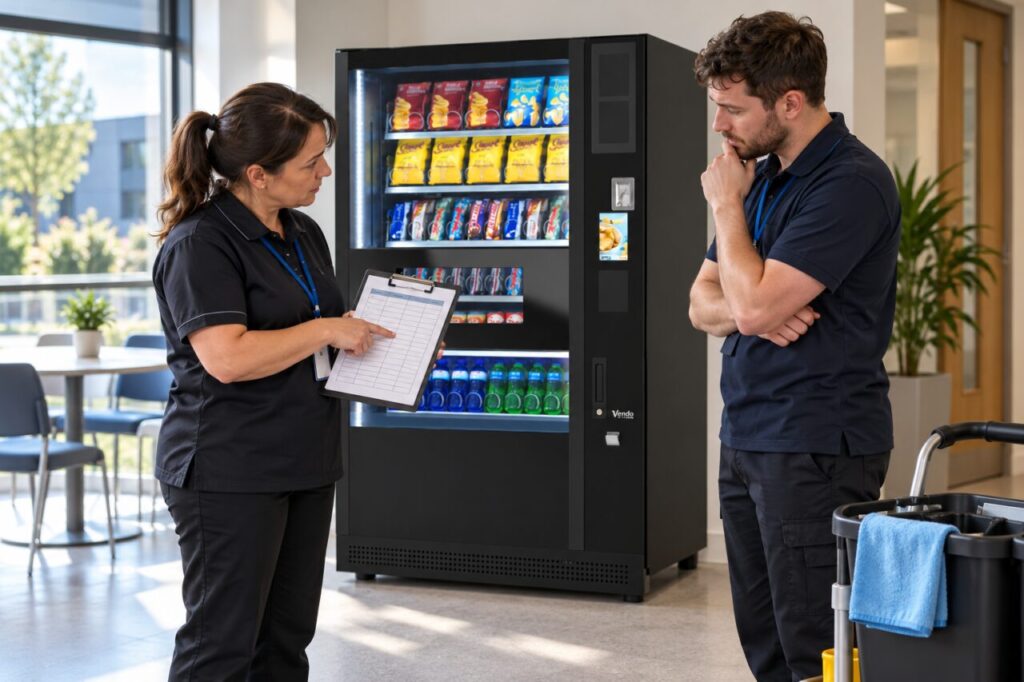
An accurate log is more useful than a tidy-looking one. Do not backdate a signature or record work on behalf of a colleague simply to remove an empty space. Follow the site’s cleaning procedure and involve the person responsible for the area when the earlier activity cannot be established.
Ask about the actual task
Identify the machine, date and task covered by the blank entry. A general room-cleaning note may not include the vending surface or collection area described in the machine checklist. Ask the relevant person what they did and whether there is another genuine record, such as a shift handover note.
Keep the answer proportionate. If the colleague remembers wiping an external surface but cannot confirm the rest of the listed tasks, record that limitation. Do not convert partial recollection into a full completed check. Similarly, a clean appearance now does not establish exactly when or how the earlier work was carried out.
Decide what needs doing now
If the earlier work cannot be verified, the responsible supervisor should decide the next step under the site’s procedure. That may involve completing an authorised task now and recording the actual time. Do not describe today’s work as yesterday’s completion, even if it addresses the same practical need.
Use the approved cleaning method and the relevant equipment instructions. Staff should not open service areas, reach into inaccessible parts or use an improvised chemical because a log is incomplete. Where the task belongs to the vending operator, report the concern through that route and record the request rather than pretending the site completed it.
Keep correction and completion distinguishable
A correction note can explain why the original row remains blank and point to the follow-up. For example, it might state that the previous shift’s completion could not be confirmed and that the authorised external task was completed at a specified time today. Use the site’s accepted correction method.
If the work was performed and the colleague can confirm it, ask how a late entry should be recorded. The person responsible for the procedure should decide what evidence and notation are appropriate. The important point is that a later reader can distinguish an entry made at the time from information added afterwards.
Find out why the entry was missed
Check whether the form was available, the machine was clearly identified and responsibility was understood. A paper sheet kept in another room may be easy to overlook. A handover between a cleaner and an operator may also leave each person assuming the other owns a particular task.
Improve the process around the specific cause. Move the approved record to an appropriate accessible location, clarify the task owner or make the handover more explicit. Avoid adding duplicate forms that require the same person to record the same activity twice without a useful reason.
Review whether the problem recurs. One blank entry may be an isolated recording error, while repeated gaps may show that the task allocation is unrealistic or unclear. Keep the response focused on reliable work and truthful records, rather than rewarding a checklist that looks complete but cannot be supported.
Related guidance: read A Vending Cleaning Log That Records the Work Actually Done for the connected question.
Send questions about operator and site responsibilities through our contact page.