
Testing Vending Collection Access Before You Buy
Choosing a vending machine involves more than checking that customers can see the products and make a payment. They also need to collect the item comfortably using the supplied equipment. Include this part of the journey in the buying assessment, particularly where the service is intended for people with a range of mobility and reach needs.
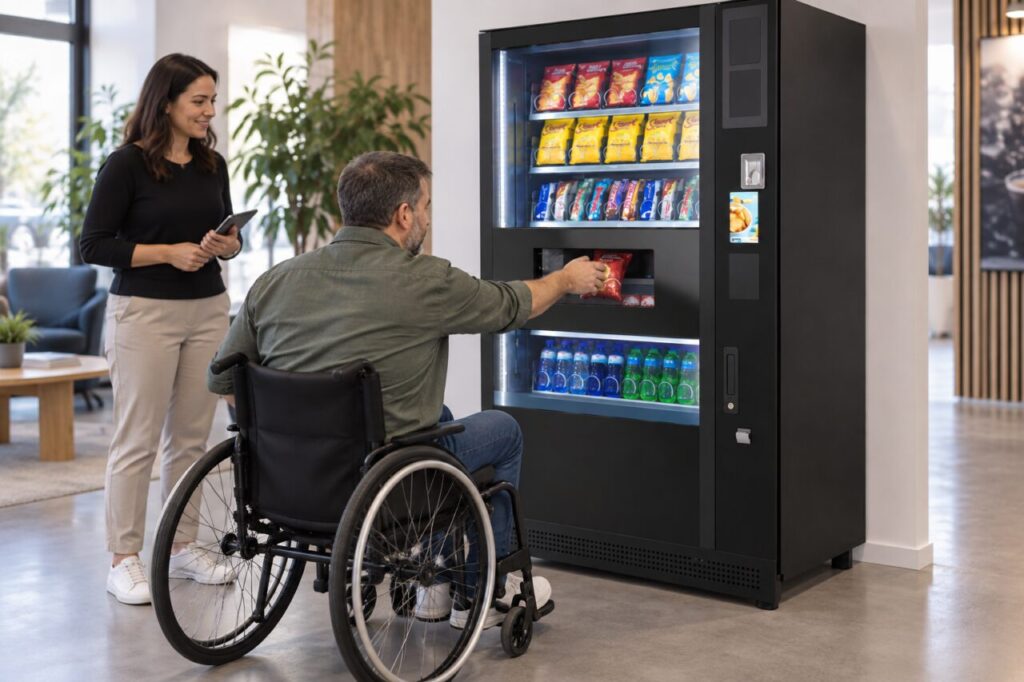
A practical usability review is not a declaration that an installation meets every accessibility requirement. Requirements depend on the site and applicable standards, which should be assessed by appropriate professionals where needed. Do not claim universal accessibility from a catalogue photograph or a single successful demonstration.
Look at the complete approach
Ask the supplier to demonstrate the actual collection arrangement on the proposed model. Note how a customer approaches, identifies the opening and retrieves the item. The collection point may be positioned differently from another machine that looks similar, so assess the specific equipment rather than relying on a general impression.
Consider the surrounding space as well as the cabinet. Furniture, queues and other obstacles can affect the experience at the intended location. Ask the responsible site team and supplier to review the proposed arrangement together. Do not invent a universal clearance figure or assume that the cabinet’s footprint describes the whole usable area.
Include relevant users respectfully
Where appropriate, invite willing people with different access needs to comment on a supervised demonstration. Explain what is being assessed and offer assistance when requested. The exercise should inform the equipment choice, not require anyone to prove an ability or disclose personal medical information to the purchasing team.
Record the practical observation rather than labelling the person. For example, note that the collection step required assistance in the demonstrated arrangement. Keep personal details out of the general buying report. One person’s experience is useful evidence, but it should not be presented as representing everyone with a similar mobility aid or access need.
Avoid unapproved modifications
If the collection arrangement does not suit the intended use, ask the supplier about appropriate alternatives. Do not alter a collection flap, remove a protective part or add a makeshift platform to force the proposed equipment to fit the requirement. Equipment changes and the site arrangement need proper assessment by the responsible parties.
Ask whether a different configuration or product option can be demonstrated, and keep any answer conditional until confirmed. A supplier’s willingness to investigate is not the same as a completed solution. Include unresolved access questions in the buying brief so they are visible before an order is finalised.
Keep the assessment connected to installation
Record the model, setup and conditions used in the demonstration. Our guide to a written test record helps preserve that information. If the final installation differs, recheck the relevant parts of the journey rather than assuming that the earlier observation automatically applies in the new setting.
When discussing vending equipment options, explain the intended audience and site constraints early. Clear information gives the supplier a better basis for recommending an arrangement to assess. The catalogue can inform the shortlist, but the practical customer journey should remain part of the decision.
After installation, keep the agreed approach and collection area usable through normal site management. Review feedback with the responsible team if difficulties arise. A useful outcome is a documented assessment and a suitable support route, without overstating what one demonstration proves about the needs of every future customer.
Discuss your site’s access needs with our team before choosing the equipment.