
Using Vending While Carrying a Bag: Test Where Customers Put Their Belongings
A vending demonstration is often carried out with empty hands and plenty of space. Real customers may arrive carrying a work bag, coat, shopping or paperwork. Before settling on a position, observe that ordinary journey. The question is not simply whether someone can stand in front of the cabinet. It is whether they can choose, pay and collect without awkwardly balancing their belongings or blocking another person.
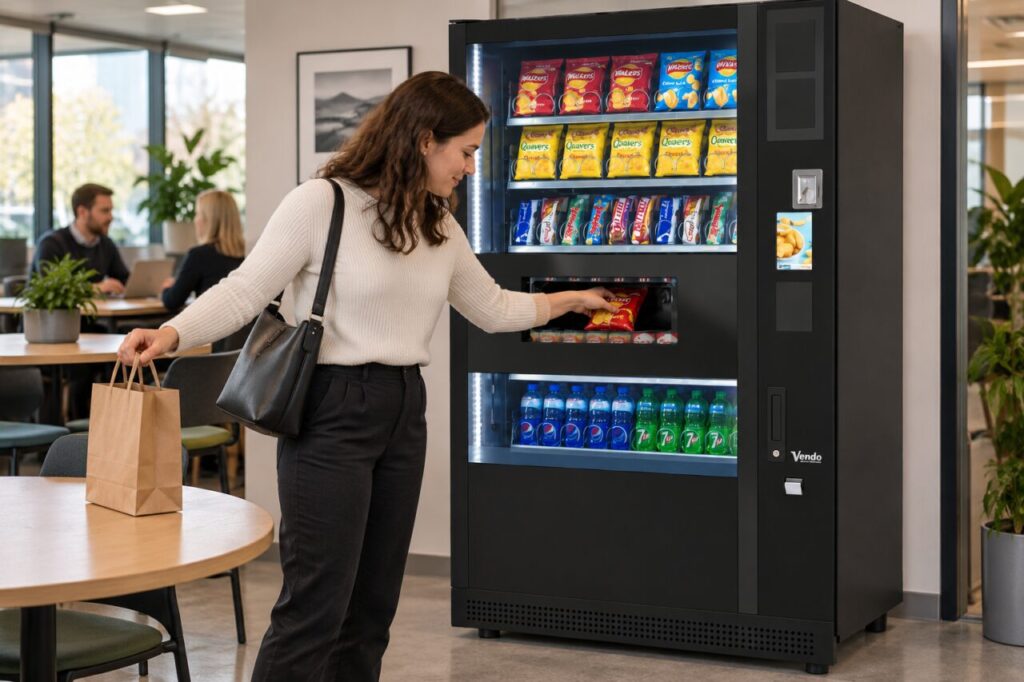
Use a realistic customer scenario
Choose a representative set of everyday items and walk through the purchase with the supplier or site host. Start from the approach route, not directly in front of the controls. Notice whether the customer needs to turn, put something down or step away to read the product information. Ask participants what felt awkward rather than assuming that one successful demonstration suits everyone.
Include people with different practical needs where they are willing to take part. Do not ask anyone to perform a difficult movement simply to prove the proposed position works. Record the obstacle and discuss an appropriate change with the responsible site team. This is a practical observation exercise, not an accessibility certification or a substitute for the building’s relevant assessments.
Look for an appropriate place for belongings
A nearby existing table or other suitable surface may help, but it must fit the space and the site’s intended use. Check that it does not narrow the route, interfere with doors or encourage bags to accumulate in the collection area. Ask the facilities team to assess any proposed addition. Do not attach shelves or accessories to the machine without the provider’s approval.
Avoid treating the top of the cabinet, a bin lid or the floor in a busy passage as a planned customer surface. The proposed arrangement should be understandable during an ordinary break. If a table serves another activity, consider whether it will actually be available at peak times. A useful surface on an empty demonstration day may be occupied during the real purchase period.
Follow the item through collection
Observe the whole sequence after payment. Where does the customer hold the purchased packet while retrieving their bag? Does another customer step forward before collection is complete? The aim is to provide enough usable space for the actual journey, including the moment when someone turns away. Do not use a nominal cabinet width as the only measure of the area needed.
Repeat the observation with the intended product formats. A single bar, a bottle and two separate purchases create different handling tasks. Do not assume that the machine supports a combined purchase or a particular collection method; test the configuration proposed by the supplier. Keep any testing supervised and within the provider’s instructions, without reaching into mechanisms or moving equipment.
Check the arrangement during normal use
After installation, ask whether customers are leaving bags in inconvenient places or asking colleagues to hold belongings during a purchase. These are useful observations for a site review. Record the time and situation without photographing identifiable customers unnecessarily. Small changes to surrounding furniture or the queue position may be worth assessing before considering different equipment.
Use this exercise when reviewing vending machine options for a workplace or shared building. It adds a practical customer-use question to the technical site survey. Keep the agreed layout, the reason for any nearby surface and the responsibility for keeping it clear in the site handover, so later furniture moves do not remove the benefit unnoticed.
Ask for a site discussion if you need to assess the purchase and collection space.
Related guidance: Can Customers Reach the Vending Collection Opening? Test the Full Journey.