
A Vending Equipment Deposit Appears on the Final Invoice: Check the Balance Calculation
When a vending equipment purchase includes a deposit, the final invoice or balance request should be checked against the payment already made. Do not assume that every document showing the full equipment price is asking you to pay that amount again. Equally, do not deduct a deposit twice because it appears in two different places.
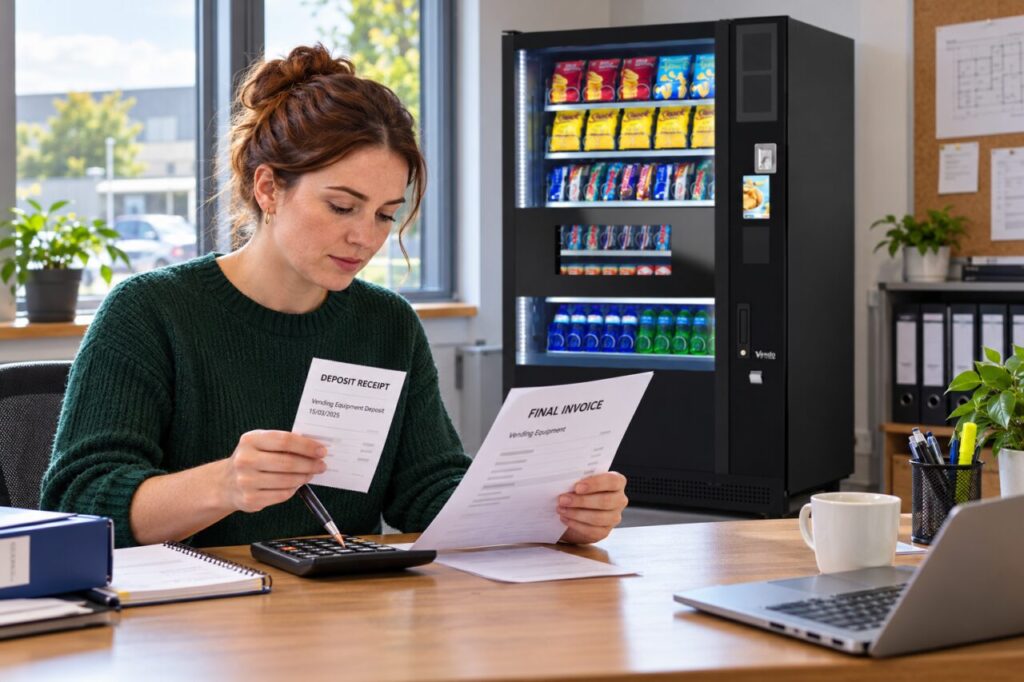
The practical task is to reconcile the agreed total, the confirmed payment and the balance requested. Keep the supplier’s documents unchanged and raise any discrepancy through the business’s normal approval process. This guide explains a basic comparison, not the tax or accounting treatment of every deposit arrangement.
Collect the relevant documents
Find the accepted quotation or order, the deposit request, proof of payment and the final invoice. Check the supplier, buyer and equipment references. If the order changed after the deposit, include the agreed revision so that the final total is compared with the correct version rather than an outdated quotation.
Confirm that the payment actually completed and was allocated to this order. A payment instruction or draft bank transfer is not the same evidence as a completed debit and supplier acknowledgement. If the reference was entered incorrectly, ask finance and the supplier to resolve the allocation before making another payment.
Rebuild the balance calculation
For a simplified example, suppose the agreed total on a consistent basis is €6,000 and a €1,500 payment has been received against it. The remaining balance is €4,500. If the final document already states balance due €4,500, subtracting €1,500 again would produce an incorrect €3,000 payment.
Conversely, a document showing the full €6,000 total may also show the €1,500 received elsewhere. Read the complete payment summary before interpreting the headline total as the amount now payable. These figures are illustrative and do not represent an equipment price, financing offer or particular tax treatment.
Explain any additional lines
Check whether the final order includes approved delivery, accessories or other changes that were not in the original total. Match each addition to the agreed scope. Do not label every difference an error, but do not accept an unexplained amount simply because the machine has already arrived. Ask for a corrected or clarified document where needed.
Use the same basis when comparing amounts. If documents display tax or other charges differently, ask the responsible finance person to reconcile them rather than adding and subtracting unlike totals. Keep recoverable security deposits or other separate arrangements distinct from a payment made towards the equipment purchase price.
Approve the actual amount due
Record the confirmed balance and the evidence supporting it in the payment approval. Use the established supplier-verification process if payment instructions change. A request to pay a new account should not be treated as routine merely because it arrives alongside a plausible invoice. Do not rely on a forwarded message alone to resolve that discrepancy.
After the final payment, retain the confirmation and supplier statement or acknowledgement with the equipment file. If a balance remains disputed or a credit is pending, record it explicitly instead of marking the purchase financially closed. A clear reconciliation lets future colleagues distinguish the equipment’s total price, payments already made and any genuinely outstanding amount without reconstructing the transaction from scattered emails.
Discuss your site and equipment requirements with Vending-Machines.ie, or send an enquiry with the questions your comparison has identified.
Related guidance: Vending Machine Invoice and Asset Details: Match Them at Handover.