A Vending Customer Drops a Payment Card: Retrieve It Safely Before Trying Again
If you drop a payment card while using vending, pause the purchase and retrieve the card only where it is safely accessible. Do not reach underneath the cabinet, into the collection mechanism or behind equipment. Ask the site host for help if the card has fallen somewhere you cannot reach without disturbing the machine.
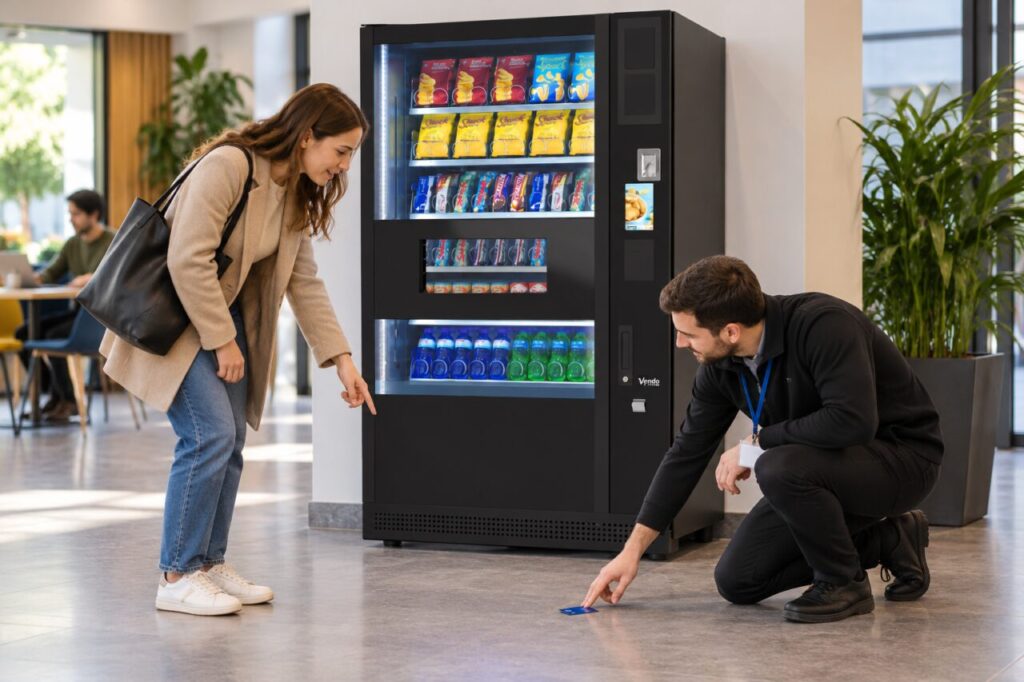
Keep the dropped card and the transaction status as two separate questions. You may need help locating the card, and you may also need to establish whether a payment was already attempted. Finding the card does not answer the payment question. Likewise, a completed purchase does not make an inaccessible card safe to retrieve yourself.
Check the area without moving equipment
Look at the clear floor and nearby surfaces from the normal customer position. If the card is visible and easily reachable without entering a restricted space, collect it carefully. Avoid blocking other people or leaving belongings in the walking route while searching. Ask the host to manage the area if assistance is needed.
If the card has slipped beneath or behind the machine, tell the host exactly where you last saw it. Do not tilt the cabinet, pull it away from the wall or insert tools into a gap. The host can contact the responsible operator or facilities team to decide whether and how retrieval can be carried out safely.
Establish what happened before the drop
Recall whether you had selected a product, presented the card or seen a payment response. Describe only the steps you remember. If a product was delivered, keep that fact separate from any uncertainty about the card. Do not make repeated purchases to test whether the first transaction was accepted while the situation remains unclear.
Ask the operator how to check an uncertain vending payment through its normal support process. Keep the machine location, approximate time and intended product available. A receipt or transaction reference may help where one exists. Avoid sending a full card photograph or revealing a PIN in a general fault report merely to identify the purchase.
Keep control of private information
If somebody finds the card, arrange its return through the site’s normal process. Staff should not need to copy sensitive card details into a public incident book. If the card cannot be recovered promptly, or you are concerned that it is no longer secure, contact your card issuer through its official channel for instructions appropriate to your account.
Do not follow contact details supplied by an unknown bystander or a newly attached notice without checking them. Use the contact route you normally trust for the issuer. The vending host may help with the physical location or transaction report, but should not make decisions about your banking security or ask to operate your banking account.
Resume only when the next step is clear
Once the card and payment status have been dealt with, decide whether you still want to make the purchase. If support has confirmed that another attempt is appropriate, follow the machine’s ordinary instructions. If uncertainty remains, use another refreshment option rather than creating more transactions that will later need to be separated.
Venues planning cashless vending should include dropped belongings in their customer-assistance arrangements. Staff need a route to the responsible operator when an item falls into an inaccessible space. Clear guidance helps customers avoid moving equipment while preserving the details needed to resolve any separate payment question accurately.
For a proposal suited to your site, contact our team with the location, expected users and your main requirements.
Related guidance: Unsure a Vending Purchase Finished? Pause Before Trying Again; You Paid for Vending with a Smartwatch: Keep the Payment Method Clear in a Query.