
A Vending Fault Happens Only When the Room Is Busy: Record the Conditions
A vending problem reported mainly during busy breaks can be difficult to investigate if the machine behaves normally during a quiet service visit. The busy period is useful context, but it does not prove the cause. Record what changes around the incident and what the customer actually observes, then let the operator assess the evidence.
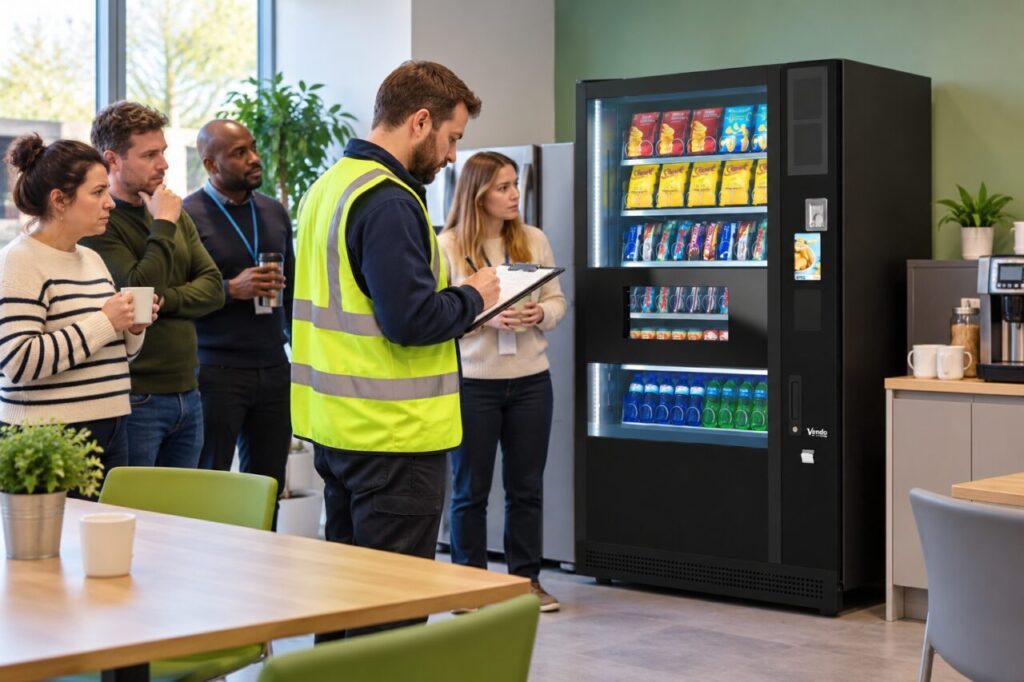
Avoid describing the machine as unable to cope with demand unless that has been established. A queue, a particular selection, a payment step or a misunderstanding may coincide with the report. Keeping those possibilities separate helps the service team ask better questions without starting from an unsupported diagnosis.
Record the incident rather than the conclusion
For each occurrence, note the date, approximate time, machine location, selection if known and observed outcome. Record any displayed message exactly if it can be read safely. State whether a product was collected and whether the customer has a payment query. If several people report problems, preserve each event rather than merging them into one vague busy-break complaint.
Ask whether the machine was already being used when the next customer approached. Do not assume that every person in the queue attempted a purchase. A useful vending service enquiry distinguishes a completed transaction, an abandoned attempt and a person who only saw a queue.
Describe the surrounding conditions neutrally
Record observations such as a scheduled break starting, people crowding the controls, a trolley occupying the collection space or customers being unsure whose purchase is in progress. Avoid collecting unnecessary personal details or filming payment activity. The aim is to understand the setting, not identify or blame individual customers.
Compare with a quieter period using the same machine and, where possible, the same product. Note what is different and what remains the same. If the fault has never been observed directly by the site contact, say that the information comes from customer reports. That distinction helps the operator judge which details still need confirmation.
Arrange a useful observation window
Share the normal busy times with the service provider and ask whether an observation during that period would help. The provider can decide what testing or monitoring is appropriate. Do not create a queue or encourage repeated paid attempts merely to reproduce the complaint. Customers should not be used as an improvised test group.
If the operator recommends a change to customer guidance or queue organisation, record when it starts. Keep the machine’s controls and collection area accessible. Any technical adjustment should be made by an authorised person. A workplace host can improve the quality of the report without opening the equipment or changing settings.
Review whether the same symptom returns
After the provider’s response, compare later reports with the original symptom. A shorter queue does not by itself prove that an equipment fault is fixed, and a new payment question may be a separate issue. Keep the service case reference and note what action was actually taken.
Agree how staff should report a recurrence and which details matter most. A small consistent record across several breaks is usually easier to interpret than a long discussion containing changing recollections. The result should be a clear account of when the problem appears, what customers experience and what remains uncertain, giving the operator a sound basis for the next step.
Related guidance: An Intermittent Vending Fault: Build a Useful Incident Timeline.
For help assessing your site, contact Vending-Machines.ie.


