
A Vending Supplier Includes a Free Case: Calculate the Effective Pack Cost
A supplier promotion offering a free case can reduce the effective cost of each vending pack, but only if the quantities and conditions are understood. Count all usable packs received and compare them with the amount actually paid. Keep the supplier’s invoice intact while using a separate calculation to assess the offer.
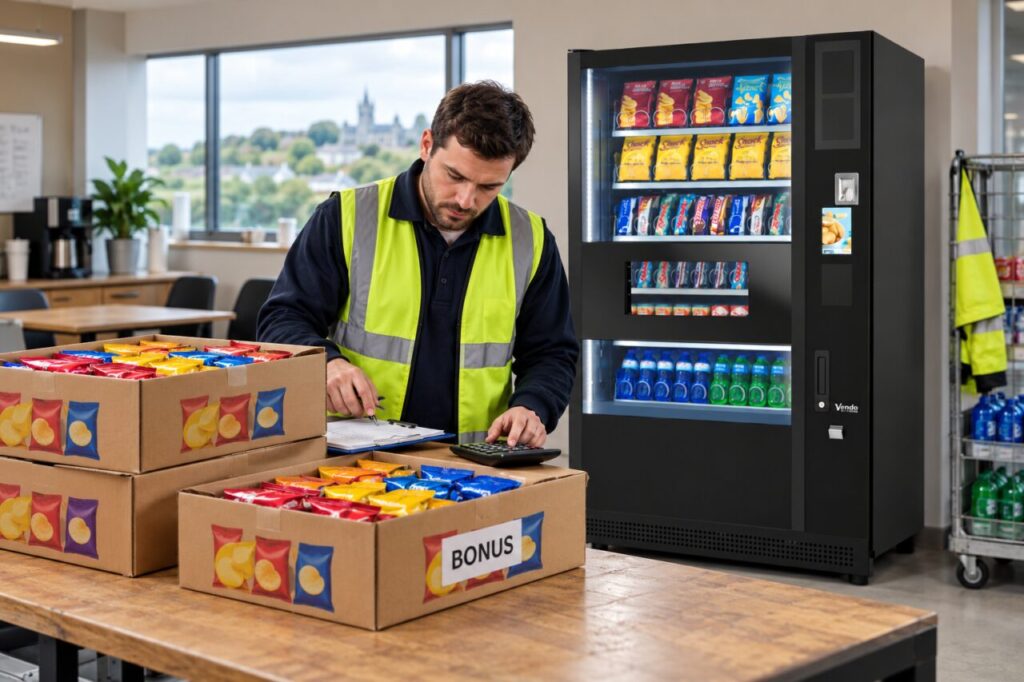
This is a purchasing comparison, not a promise of extra profit. A lower cost per pack does not help if the additional stock cannot be used appropriately. Check product suitability, shelf life and expected demand before allowing the word free to drive the order quantity.
Confirm what the offer includes
Check the product, pack size and number of sellable units in each case. Establish whether the bonus case contains the same item or a different product. The simplest combined unit-cost calculation applies to identical packs; a mixed-product promotion needs a more careful allocation that the business can explain consistently.
Record any qualifying order quantity, delivery charge or other condition shown in the offer. Ask the supplier to confirm missing details. Do not assume that a bonus applies to every order or that it continues after the promotion ends. Keep the offer date and terms with the purchasing record.
Work through the actual quantities
Suppose, purely as an example, you pay €120 for ten cases containing 12 identical packs each and receive one additional case of 12 packs at no extra charge. The delivery contains 132 packs. Dividing €120 by 132 gives approximately €0.91 per pack before any separately applicable costs or adjustments.
Without the bonus case, €120 divided by 120 packs is €1 per pack. The difference is about nine cents per pack on this simplified basis. Do not call the bonus case pure profit: it changes the average purchasing cost and the quantity held, while selling prices, operating costs and eventual sales still matter.
Check the received stock
Verify that the bonus case actually arrived and that the pack count matches the offer. Record any shortage or unsuitable stock through the supplier’s normal process. Do not calculate a lower unit cost using a promised case that has not been received. Keep expected and received quantities separate until the discrepancy is resolved.
Review the stock’s suitability for your planned use, following the operator’s normal food and inventory procedures. Extra packs may require more storage or a longer selling period. If they displace other products that customers regularly buy, the apparent saving needs to be considered alongside that effect rather than in isolation.
Keep the comparison repeatable
Save the invoice amount, included quantities and calculation basis. If delivery costs are allocated to stock in your purchasing analysis, apply the same method when comparing the promotional offer with an ordinary order. Ask the responsible finance person about formal accounting treatment rather than changing inventory values ad hoc from a blog example.
For the next order, compare the normal replenishment price as well as the promotional average. A temporary bonus should not become the permanent cost assumption in a long-term vending forecast. The useful conclusion is specific: this received order supplied a stated number of usable packs for a stated cost. Future orders and actual sales need their own evidence before the saving is treated as recurring.
Discuss your site and equipment requirements with Vending-Machines.ie, or send an enquiry with the questions your comparison has identified.
Related guidance: Vending Stock Bought at Two Costs: Calculate a Weighted Unit Cost.