Vending Stock Bought at Two Costs: Calculate a Weighted Unit Cost
When the same vending product is bought at two different unit costs, taking the simple average of the two prices ignores how many packs were bought at each price. A weighted average accounts for the quantities. It can help explain a stock-cost calculation, provided the product and cost basis are consistent.
Use this as a transparent arithmetic example and follow the inventory method agreed with your finance professional for formal records. Do not change accounting methods casually or confuse a management estimate with the cost of a specific physical pack. Keep the original invoices and quantities available behind the summary.
Confirm that the units match
Check product name, variant, pack size and saleable units per case. Two prices for different pack sizes should not be pooled as though they described identical items. Convert each case into its actual saleable unit count before calculating. Keep damaged, returned or disputed quantities visible rather than assuming every invoiced item is available for sale.
Use the same cost basis for both purchases. Establish how delivery, discounts and other adjustments are handled under your records. Do not compare one cost including an allocation with another excluding it. If an invoice or credit is unresolved, mark the calculation provisional and explain which input may change when the paperwork is complete.
Multiply each cost by its quantity
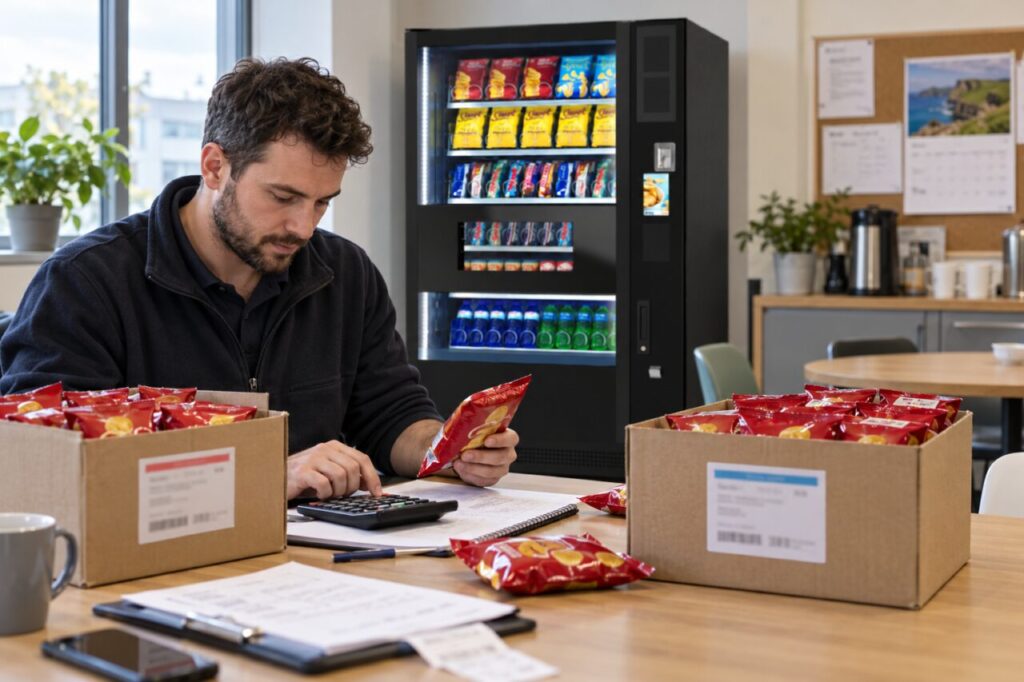
Imagine buying 100 identical packs at €0.80 and another 50 at €1.10. The first purchase costs €80 and the second costs €55. Together, 150 packs cost €135. Dividing €135 by 150 gives a weighted unit cost of €0.90. These figures are invented for explanation, not actual supplier prices.
The simple average of €0.80 and €1.10 is €0.95. That would give the smaller, more expensive purchase the same weight as the larger purchase. Multiplying €0.95 by 150 would produce €142.50, which does not match the actual €135 total in this example. Reconstructing the total is a useful check for this kind of mistake.
Understand what the average represents
OpenStax describes weighted-average inventory cost using total costs and quantities. Your practical calculation still needs a defined scope: a period’s purchases, a specific stock pool or another agreed basis. Do not call an average of recent purchases the cost of all remaining stock if earlier quantities are excluded.
Physical rotation and cost calculation also serve different purposes. Continue the appropriate stock-rotation and traceability procedures rather than rearranging packs to match an accounting average. The average does not erase batch details, storage instructions or date markings, and it should not replace the information needed to manage the actual food safely.
Use the result without hiding the next purchase
A blended cost can describe the selected stock pool, but the next order may be available only at a new price. Keep replacement-cost information visible when planning future margins. Otherwise, an attractive historical average can conceal that the next refill will require more cash or produce a different contribution at the same selling price.
Retain enough decimal precision during the calculation and round the displayed result consistently. If the rounded unit amount does not reconstruct the total exactly, keep the underlying total as the primary record and explain the rounding. Avoid repeatedly multiplying an already rounded figure through several reports and treating the resulting difference as missing stock.
When developing a vending business budget, separate historical purchase cost from the current replenishment quote. Both are useful, but they answer different questions about recorded performance and the cash needed for the next stock order.
For a proposal suited to your site, contact our team with your location, expected users and main requirements.
Related guidance: Vending Stock Sold at Two Prices: Calculate Revenue Before Using an Average.