
Opening Stock in a Vending Quote: Clarify What Is Included
A vending quotation may show a fully stocked machine in its photograph without including the products displayed. Ask explicitly how opening stock is handled. The answer affects the launch plan, the initial order and the responsibilities of the people receiving the equipment and preparing it for customers.
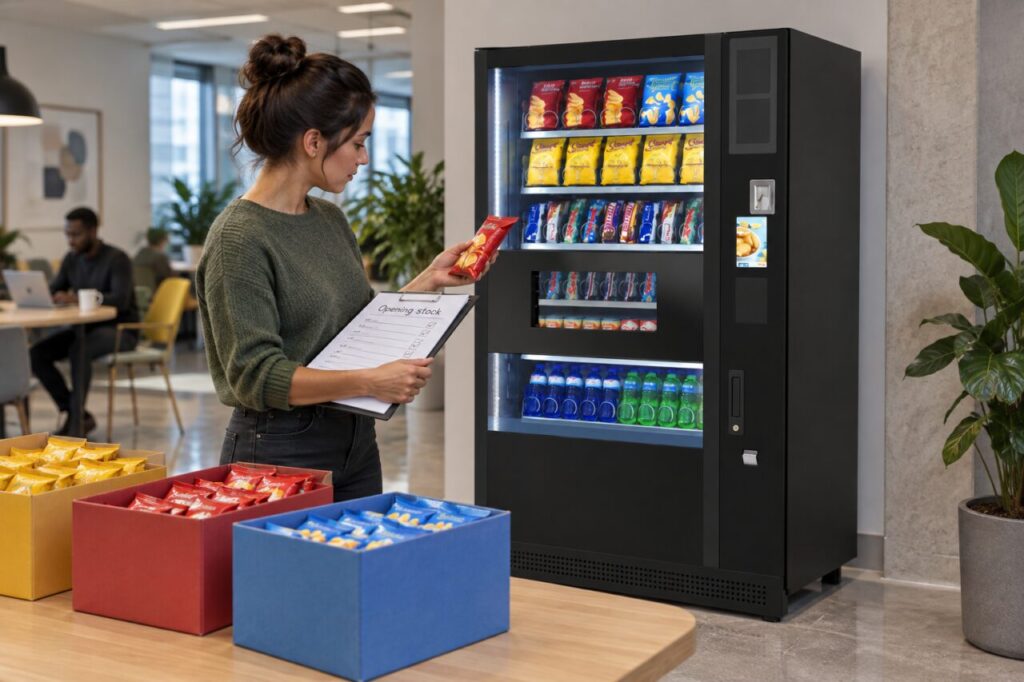
Treat stock as a separate part of the scope, even where the provider supplies a complete service. Do not assume that purchase, hire and managed arrangements include identical opening quantities. The relevant information is what the supplier confirms for the proposal you are actually considering.
Identify the included items
Ask whether the quotation includes stock and, if so, how that stock is described. Look for product types, quantities or another clear basis for the allowance. A phrase such as starter pack should be explained before it is treated as a complete launch range, particularly if several people will approve the purchase.
Confirm whether product choices are fixed or subject to an agreed selection process. If availability may affect the range, ask how alternatives will be discussed. Do not interpret a catalogue image as a guaranteed list of brands, pack sizes or quantities that will arrive with the machine.
Separate purchase and loading quantities
Opening stock may involve more products than the machine receives in its first fill. Ask how the order relates to the planned loading arrangement and any remaining stock. The guide to case sizes and stock storage explains why the ordering unit and machine capacity should be considered separately.
Use the supplier’s guidance for product suitability and loading. A box supplied alongside the cabinet is not an instruction for untrained site staff to fill it themselves. Confirm who performs the initial loading and what training or service arrangement applies to later replenishment.
Coordinate the arrival sequence
Check whether products arrive with the equipment or through a separate delivery. Identify who receives them and what suitable storage is available under the product instructions and the site’s stock procedures. A machine delivery date does not necessarily describe when every product will be ready for launch.
If installation changes, ask how the stock plan is affected. Do not bring products forward unnecessarily because the original calendar showed an earlier opening. Keep any revised delivery or storage arrangement agreed with the responsible parties, and avoid treating a temporary room or corridor as suitable stock space without assessment.
Keep ownership and records clear
Ask who owns the opening stock under the arrangement and how it is recorded. This can matter where the site hosts a managed service or funds a particular trial. Keep the answer with the agreement rather than relying on an assumption that everything on site automatically belongs to the host business.
At receipt, compare the actual delivery with the confirmed scope and record differences through the normal process. Our guide to linking stock receipts and deliveries provides a practical record structure. Keep stock information separate from the equipment inventory while linking both to the launch plan.
When comparing vending quotations, include opening stock in the questions before approving the overall cost. A clear answer explains what is supplied, who handles it and what remains for the site to arrange. That helps the first customer-facing day reflect the agreed service rather than an assumption based on the machine’s promotional photograph.
Ask our team to clarify the opening-stock scope for your proposed equipment or service.