An Untrained Colleague Offers to Help Refill Vending: Choose Safe Support Tasks
A colleague may offer to help when a vending refill is busy, but willingness is not the same as training or authorisation. The experienced operator should decide whether useful support can be given without involving the colleague in equipment tasks they have not learned. Keep responsibility for the refill clear throughout the visit.
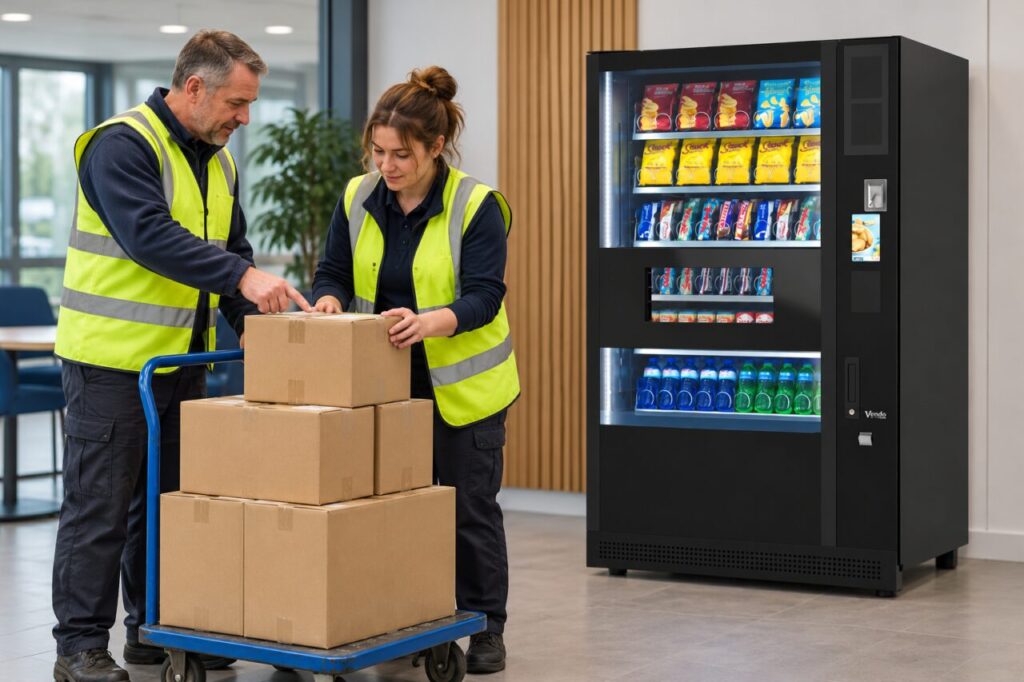
Begin by explaining the boundary of the help requested. A person may be able to read a delivery note or count sealed cartons at a safe work point, subject to the site’s procedures. That does not make them responsible for opening the machine, loading selections, changing settings or handling a fault.
Choose a defined support task
Give one specific task with a clear result, such as checking the number of sealed cases against the delivery list. Explain the counting unit and where the result should be recorded. Avoid vague instructions such as ‘help with the stock’, which can lead the colleague to move or open items the operator has not yet checked.
Consider whether the task requires its own instruction or assessment. Moving heavy cartons, using a trolley and handling food stock are not automatically suitable simply because they happen outside the machine. Follow the employer’s procedures and the person’s training. If there is no appropriate task available, decline the help and arrange proper cover rather than improvising.
Keep control of equipment access
The authorised operator should retain responsibility for keys, equipment access and the approved refill method. Do not share credentials or leave an open machine under the supervision of someone who has not been authorised for that role. Explain what the colleague should do if a customer asks for help while the operator is occupied.
Ask the supplier about training when arranging vending equipment and operating support. The exact tasks depend on the machine and service arrangement. A general article cannot substitute for the manufacturer’s instructions or the employer’s assessment of who is competent to carry out a particular task on the equipment.
Make the count easy to verify
Use a simple record showing the product, quantity, counting unit and the person who checked it. Keep different products and part-used cases distinguishable. The operator should review the result before relying on it for the refill. A helpful colleague should not be left to resolve unexplained stock discrepancies or substitute products independently.
For example, the helper may report two sealed cases and one open case without assuming how many individual packs remain in the open one. The operator can then arrange the appropriate count. Recording uncertainty honestly is more useful than producing a neat total based on an unverified case conversion or an estimated number of loose packs.
End the assistance with a handover
Before the colleague leaves, confirm what was completed, what remains unchecked and where any paperwork has been placed. Remove temporary ambiguity about who is doing the next task. If the assistance exposed a regular staffing gap, record that as a planning issue rather than treating occasional informal help as a dependable operating arrangement.
Where the colleague may become a regular cover operator, arrange the relevant training and practical sign-off through the responsible manager. Keep that future role separate from today’s limited assistance. A well-defined support task can be useful, but the refill should remain under the control of people who understand the equipment, the stock procedure and their own responsibilities.
Related guidance: Training a New Vending Operator: Budget for Supervised Practice.
For help assessing your site, contact Vending-Machines.ie.