
Vending Stock Bought in Mixed Cases: Calculate the Cost of Each Sellable Pack
A mixed case of vending snacks can have one invoice price but several different products inside. Dividing the total by the pack count gives an average cost, which may be useful, but it does not automatically establish the cost of each individual product line. Keep the contents, quantities and allocation method visible. This makes pricing and margin reviews more reliable when some products sell faster or at different prices.
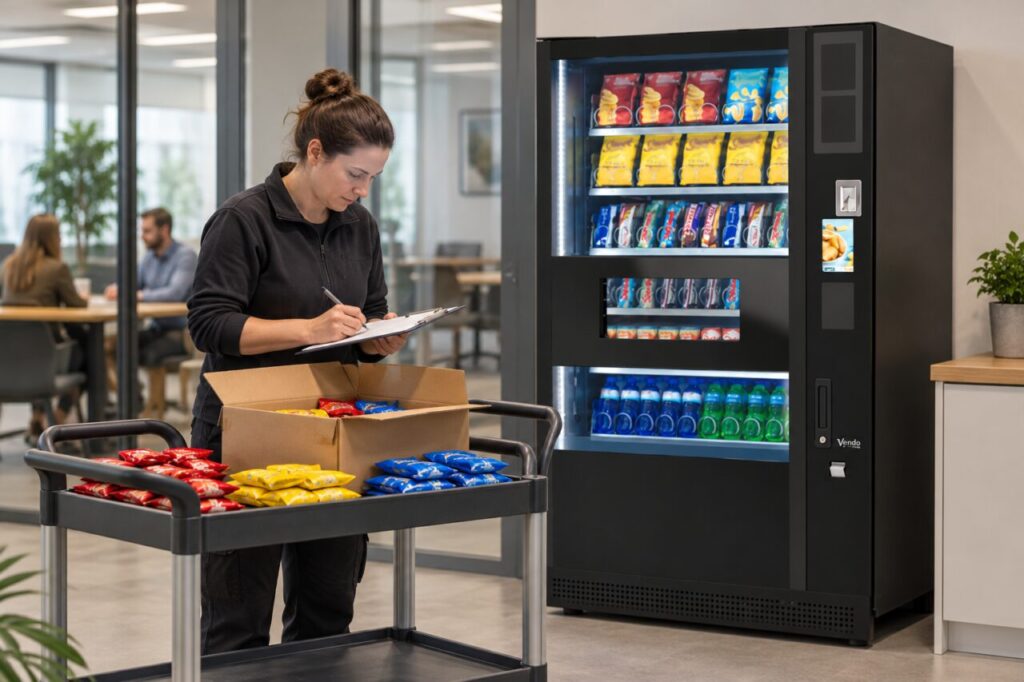
Count the sellable units first
Check the delivery against the supplier’s description and invoice. Record how many individual packs of each product are included, along with their sizes. Do not confuse an outer multipack with the unit that will actually be sold. If a pack is unsuitable for individual sale or for the equipment, resolve that with the supplier before treating it as available vending stock.
Record damaged, missing or substituted items separately. A case described as containing thirty packs should not be costed as thirty usable items if the received contents differ. Keep the supplier query or credit note linked to the original purchase. Avoid silently changing the unit count to make the calculation fit the invoice total.
Understand what an average tells you
Consider a hypothetical case costing €24 for thirty sellable packs, excluding delivery and any tax treatment. Dividing €24 by thirty gives an average of €0.80 per pack. That calculation is correct for the case as a whole. It does not prove that each flavour or product type has the same underlying purchase value, especially if the supplier lists different component prices.
If a detailed allocation is needed, ask the supplier for the breakdown and agree a consistent method with the person responsible for your records. Do not invent product-specific costs merely to create a more detailed spreadsheet. The Local Enterprise Office guidance on projections supports making assumptions explicit; label an average as an average rather than presenting it as measured line-level cost.
Keep purchasing and sales linked
Map the received products to the stock names used in your vending records. Similar pack designs or abbreviated invoice descriptions can conceal different sizes. Keep a stable reference so that sales of one item are not accidentally compared with the cost of another. Where the range changes, retain the previous mapping for the period in which it applied.
The vending business guide provides the wider operating context. For this particular decision, track which mixed-case products remain unsold as well as which sell quickly. A low average purchase price may be less useful if it requires repeatedly buying slow-moving items to obtain the popular ones.
Compare the whole purchasing choice
Compare a mixed case with separate cases using the same scope: quantities, delivery charges, expected use and storage needs. Do not assume all units will sell simply because the average cost is attractive. Keep any estimated unsold stock separate from observed results, and review the estimate once actual sales and remaining stock are available.
For formal accounts or tax treatment, use your accountant’s advice and the actual supplier documents. This is an operational costing example, not a prescribed accounting method. A useful mixed-case record lets you reconstruct what arrived, what it cost and how the products were used. That evidence is more valuable than a precise-looking unit figure whose assumptions have been forgotten.
Related guidance: Comparing Vending Stock Case Prices: Work Out the Cost per Pack.
Planning vending at your site? Contact the team with your location, equipment details and requirements.