Vending Stock Loss Percentages Use Different Bases: Compare the Same Denominator
A vending stock-loss percentage is incomplete without the quantity it is measured against. Five missing packs out of a delivery of 100 is not the same calculation as five packs compared with 50 recorded sales. Both produce a percentage, but they answer different questions and should not be presented as interchangeable measures.
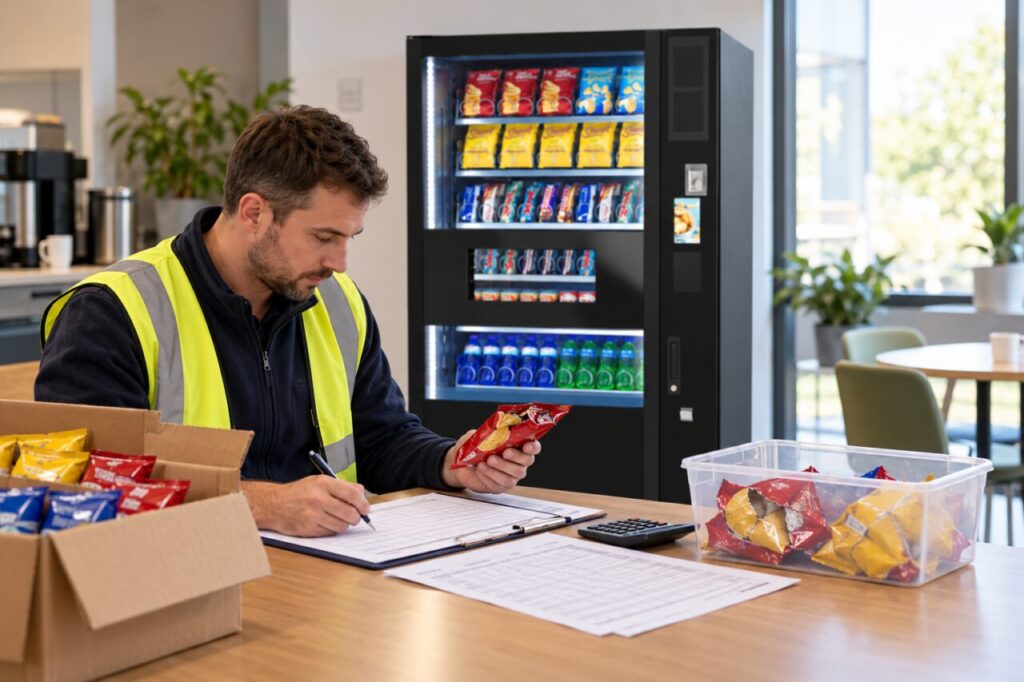
Before comparing sites or reporting an improvement, write the formula beside the result. Define the period, product unit and reason for each adjustment. Keep verified waste, transfers, count corrections and unexplained differences separate in the underlying record. Calling every difference a loss can hide a paperwork problem that requires a different response from damaged stock.
Define the numerator first
The numerator is the quantity being reported at the top of the fraction. For a waste measure, this might be the number of packs recorded as discarded during the period. For an unexplained stock difference, it may be the gap remaining after the expected and counted quantities have been reconciled. These are different categories, even if both reduce available stock.
Use consistent units. A carton, individual bar and multipack cannot be added as if each were one equivalent item. Retain product-level records and explain any conversion into saleable packs. Do not infer theft or equipment failure from a numerical gap alone. Check deliveries, sales, transfers and the count procedure before deciding what the remaining difference means.
Choose a denominator that matches the question
Suppose five packs were discarded from 100 packs received in an illustrative period. Five divided by 100 is 5%. If the same period had 50 sales, five divided by 50 is 10%. The first expresses discarded packs relative to receipts; the second relative to sales. Neither result should be relabelled as the other to make performance look better.
Receipts may not be the best basis for every review. Stock can remain from earlier periods, and a large delivery just before month end can change the ratio without any change in handling quality. Choose the measure for a stated operational purpose and retain the quantities needed to interpret it. There is no universal percentage supplied by this example.
Make comparisons consistent
Compare the same definition over equivalent periods before describing a trend. If one site includes damaged deliveries and another excludes them, the percentages are not directly comparable. Record a shared rule and, where feasible, recalculate both from the original records. If the underlying detail is missing, label the comparison as limited rather than manufacture a matching result.
Show counts alongside percentages, especially for small samples. One discarded pack out of ten is 10%; one out of 100 is 1%. The same count produces a different rate because the base differs. This does not make the percentage useless, but it shows why a single quiet week can be a poor basis for a major range decision.
Turn the measure into a specific action
If the records show repeated damage to a particular product during handling, review that process with the responsible operator. If the difference disappears after a transfer is recorded, correct the record and retain the explanation. Avoid changing stock quantities merely to force the percentage towards a preferred target. The audit trail should explain what actually happened.
For wider vending business planning, keep the loss measure connected to stock quantities and costs. Record the formula, source documents, unresolved differences and next review date together. A consistent measure helps identify a useful intervention; an unexplained percentage mainly creates arguments about whether two people are counting the same thing.
For a proposal suited to your site, contact our team with the location, expected users and your main requirements.
Related guidance: A Vending Stock Count Was Wrong: Correct Inventory Without Inventing Sales.