
Vending Trial Product Sells Out Early: Decide What the Test Shows
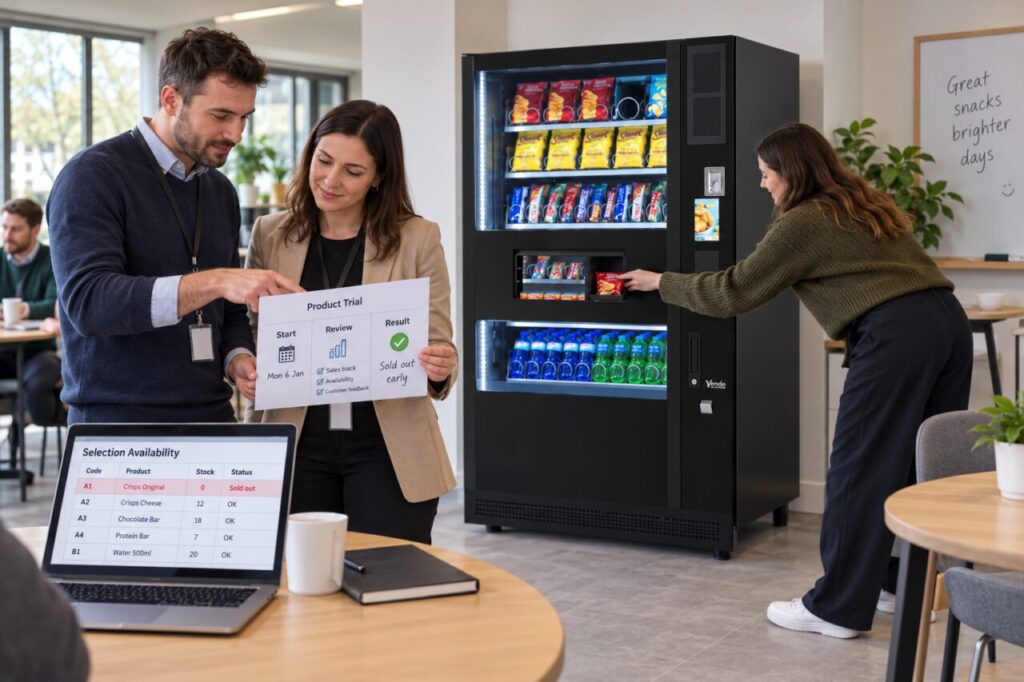
A new vending snack sells out before its planned review date. That is useful information, but it does not answer every question the trial was meant to test. A small initial quantity may disappear quickly through curiosity, while a larger quantity might reveal a different pattern over time. Record what was available and when it ran out before declaring the product a permanent success or comparing its sales with items that remained in stock throughout the period.
Describe the result without overstating it
Start with the quantity loaded, any replenishment and the period during which the item was available. If the exact sell-out time is unknown, record the last confirmed availability and the first confirmed empty check. Do not convert that uncertain interval into a precise hourly sales rate. A clear description of the evidence is more useful than a confident figure built on an assumed moment of sale.
Keep the original trial question visible. If the aim was to test whether staff would try a requested product, an early sell-out may provide one kind of evidence. If the aim was to assess repeat demand across several weeks, the same event may leave the question unresolved. The result should be interpreted against the purpose of the test, not simply against an expectation that an empty selection always proves the same thing.
Account for the unavailable period
Mark the days or hours when customers could no longer buy the trial item. A low total over the full calendar period can be misleading if stock was absent for much of it. Equally, projecting the initial sales pace across the unavailable period would assume that demand continued unchanged. Keep actual purchases separate from any estimate and avoid presenting potential missed sales as measured transactions.
Note other relevant conditions, such as an office event, unusual attendance or a temporary reduction in alternative products. These observations do not automatically explain the sell-out, but they help frame the next decision. If customers requested the item after it ran out, retain that feedback without counting every comment as a guaranteed future purchase. Interest and recorded sales are useful but different kinds of evidence.
Decide whether a further test is practical
Discuss replenishment with the responsible operator, considering availability, suitable stock quantities and the agreed service arrangement. A continuation may help answer the original question, but it should be deliberate rather than an indefinite extension because the first batch disappeared. Agree the next quantity and review point using the site’s circumstances. Do not order a large permanent supply solely to avoid another empty selection during a small exploratory test.
If the follow-up changes the price, position or competing range, record those changes. They can affect how comparable the next period is with the first. It may still be sensible to change the setup, but the review should then acknowledge that it is observing a revised arrangement. Keep the first result rather than overwriting it with the later figures, so the reason for continuing remains understandable.
Make the eventual range decision explicit
At the next review, consider actual availability, purchases, relevant feedback and the operational implications of keeping the item. Ask which existing choice or quantity would change if the product became permanent. A successful trial does not create extra machine capacity by itself. The final decision should reflect the wider range and the needs of the people using the site, alongside the evidence collected for this particular snack.
When reviewing vending options for your premises, agree how product trials and replenishment decisions will be recorded. An early sell-out is a reason to examine the test carefully, not a reason to invent demand or discard the result. A short, clearly documented continuation can provide a more useful answer where the first quantity was insufficient to observe the pattern the site wanted to understand.
Contact our team to discuss product planning for your site.
Related guidance: Introducing a New Vending Snack: Set the Trial Question Before Stocking It.