
Using Vending While Wearing Work Gloves: Test the Customer Journey Before Launch
Work gloves are easy to overlook during a vending demonstration conducted by people in ordinary office clothing. At a workshop, warehouse or production site, customers may arrive for a break wearing gloves or carrying them after leaving a work area. That changes how they approach controls, payment and collection.
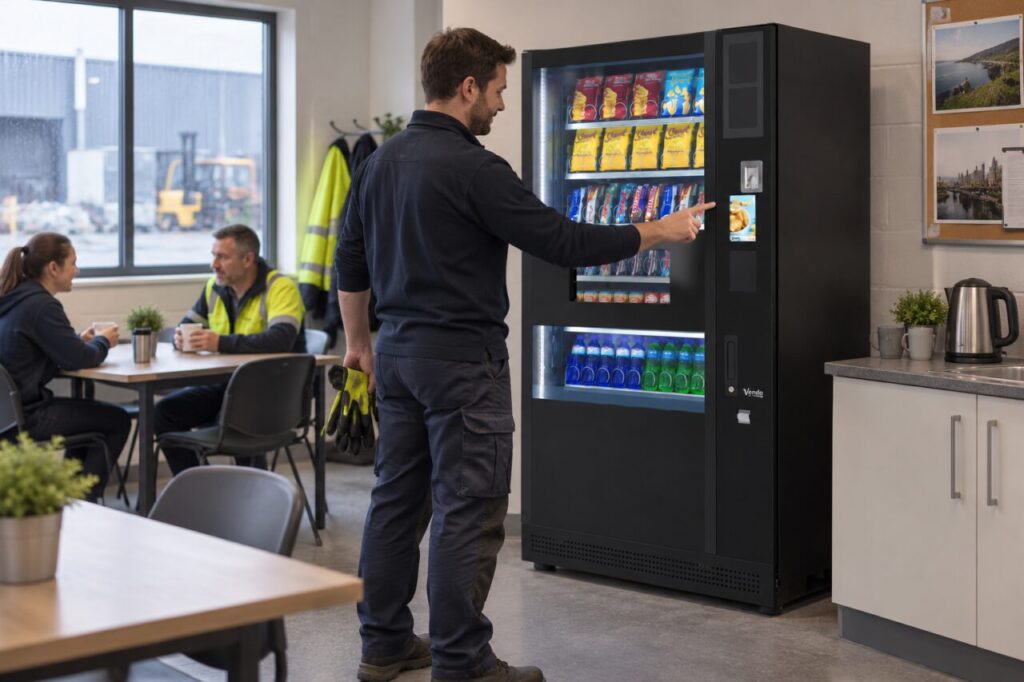
Test the complete customer journey in the real workplace context before launch. Do not assume a touchscreen is designed for every glove, and do not ask staff to ignore the protective-equipment rules of their job. The site should decide where and how workers can safely prepare for a break.
Start with the break-area boundary
Ask the site’s responsible person whether gloves should be removed before entering the refreshment area and what hand-cleaning arrangements apply. Follow the workplace’s own hygiene and safety procedures. Vending instructions should support those procedures rather than create an exception beside the machine.
Identify somewhere suitable to keep personal belongings while buying a product, if needed. Gloves should not have to be placed on the machine’s collection area or on a food-preparation surface. The solution may be part of the room layout, not a feature that needs to be added to the machine.
Observe what people actually carry at shift change. A customer might have gloves, a phone, a drink bottle and an access card. A demonstration that uses only one free hand and none of these belongings can miss a practical difficulty that becomes obvious during the first busy break.
Test the approved way to use the controls
Ask the supplier which interaction method is supported by the proposed equipment. Do not promise glove-compatible operation from the appearance of a screen. If staff need to use bare, dry hands in the break area, make that sequence clear and check it is workable within the site’s procedures.
The official SandenVendo G-Snack Evolution specification, for example, identifies a touchscreen. That description alone does not establish compatibility with every work glove. Equipment claims should come from the relevant supplier documentation or a confirmed demonstration, not an assumption about touch technology.
Avoid pressing harder, using sharp objects or adding improvised styluses when a control does not respond as expected. Record the difficulty and ask for the supported approach. A damaged control surface would create a larger problem than the original usability question.
Include payment and collection in the trial
Have a representative user follow the ordinary purchase sequence under supervision. Check whether payment can be completed without juggling equipment and whether the customer can retrieve the product comfortably. Use the payment methods actually included in the proposed setup rather than a feature shown on another machine.
Allow enough time to observe hesitation. A user who pauses to store gloves or clean their hands has not necessarily encountered a machine fault. The question is whether the layout and instructions make the sequence understandable and convenient without compromising the site’s requirements.
Ask different users for feedback rather than relying on the most experienced operator. A straightforward explanation from one colleague can reveal an awkward step that a technical demonstration has normalised. Keep the feedback specific to the action, not a judgement about the customer’s ability.
Turn the result into a practical launch decision
Record what was tested, the approved interaction method and any room-layout change needed. Resolve important obstacles before introducing the service. If the proposed equipment cannot meet the site’s needs, discuss alternatives through the vending equipment selection process instead of leaving customers to improvise.
Keep the final guidance short and consistent with workplace procedures. Revisit it if protective equipment or the break-area layout changes. The useful outcome is a customer journey that staff can repeat comfortably during an ordinary shift.
Related guidance: Using Vending While Carrying a Bag: Test Where Customers Put Their Belongings.
Planning or reviewing vending at your site? Contact the team with your location, equipment details and the question you would like to resolve.