Office Vending Feedback Requests Opposite Changes: Turn the Disagreement into a Testable Choice
Office vending feedback can point in opposite directions: one group wants more familiar snacks while another wants a changing range. Treat those comments as different needs to understand, rather than a vote that one side must lose. A focused comparison can reveal whether the disagreement concerns choice, availability, price or the timing of purchases.
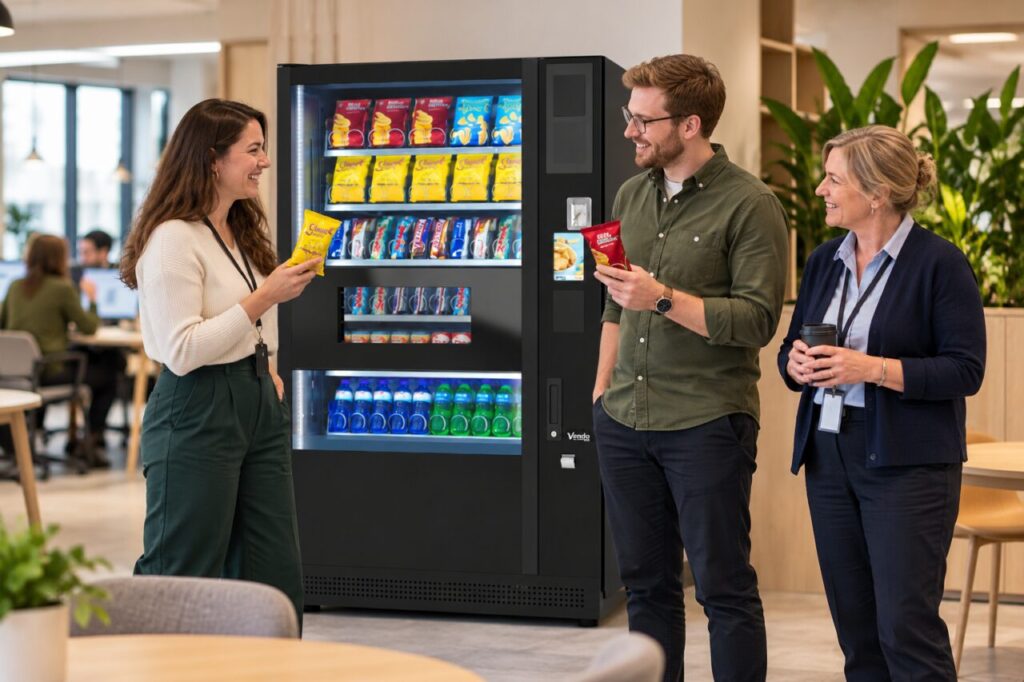
Begin by asking each group what problem they are trying to solve. “More variety” might mean a favourite is often unavailable, while “keep the range stable” might mean people cannot find a dependable option. Write down the underlying need in plain language before deciding that the machine needs more product lines or a complete range change.
Identify the practical constraint
Check what can actually be changed within the agreed service. Space, suitable packs, supply and the operator’s stocking arrangements all affect the available options. Do not promise every suggestion a permanent place. Ask the operator which choices can be trialled and whether a proposed change would remove something other customers regularly rely on.
Separate essential information or access concerns from taste preferences. A customer who cannot identify an appropriate product may need clearer product information rather than a popularity contest. Avoid inferring dietary suitability from a product’s name or from colleagues’ opinions. Any relevant product claim should be checked against the actual pack and reliable supplier information.
Choose a question a trial can answer
Frame one practical question, such as whether a rotating optional selection attracts purchases while keeping a familiar core available. Agree what will remain unchanged and which part will vary. If price, placement and several products all change together, the results may not tell you which change helped or disappointed the people giving feedback.
Set a review period with the operator and explain it to staff. Do not present a test as a permanent promise. Record availability during the trial so that an empty selection is not interpreted as a lack of interest. Ask people who wanted the change whether they tried it and whether it addressed their original problem.
Compare behaviour and comments carefully
Use sales information that the operator can legitimately provide, alongside concise feedback. A high-selling product does not automatically answer every staff need, and a strongly worded comment does not establish how many people share it. Keep the scale of each observation visible rather than treating a small group discussion as a measured whole-office survey.
When reviewing office vending options, discuss how the range can be adjusted within the actual service arrangement. The useful outcome may be a stable core with limited rotation, a different balance of choices or clearer availability communication. The trial should inform that discussion without implying that any one solution suits every workplace.
Explain the resulting decision
At the agreed review, state what was tested, what was observed and what will happen next. Acknowledge the needs that remain unresolved. If an option cannot be retained, explain the practical reason without criticising the people who requested it. Keep the original question visible so the conclusion does not drift into a different debate.
Give staff a clear route for future suggestions and avoid reopening the entire range after every isolated comment. A scheduled review can make feedback manageable while leaving room for genuine problems to be reported promptly. Opposing preferences become easier to handle when the site explains the constraint, tests a specific choice and communicates the evidence behind the decision.
Related guidance: Office Vending Feedback: Turn Vague Comments into Useful Questions.
For help assessing your site, contact Vending-Machines.ie.